
Where to stay
Staying at a ryokan
Ryokan, the Japanese inn: check-in, yukata, kaiseki dinner, the bath and futons. How a night works, with two ryokans tested near Mount Fuji and in Hakone.
On this page
A ryokan is a traditional Japanese inn. You sleep on futons laid out on tatami mats, wear a yukata, have dinner in your room and soak in hot water. I stayed at two ryokans, one facing Lake Kawaguchi and the other in a gorge in Hakone. Here’s how a night goes, from check-in to checkout.
At a glance
- Check-in
- around 4 p.m.tea and a sweet on the house
- Dinner
- kaisekiserved in your room, between 6:30 and 7 p.m.
- Bath
- private or sharedin the evening and when you wake up
- Good for
- one or two nightsnot if you want to go out at night
What is a ryokan?
It’s the traditional Japanese hotel. The room is covered in tatami mats, with no bed and no chairs. The price is usually listed per person, and it includes dinner and breakfast.
At both of mine, the rate I booked covered two people, dinner, breakfast and the local accommodation tax. The price changes a lot depending on the date and how far ahead you book, so the only figure that means anything is the one Booking.com gives for your dates.
Many ryokans are built near a hot spring, and the bath is part of the stay. Around Mount Fuji you’ll find them along the lakes and in the Hakone valleys.
My two nights:
- Wakakusa no Yado Maruei, in Fujikawaguchiko. The building is modern, the room faces the lake and the bath is on the balcony.
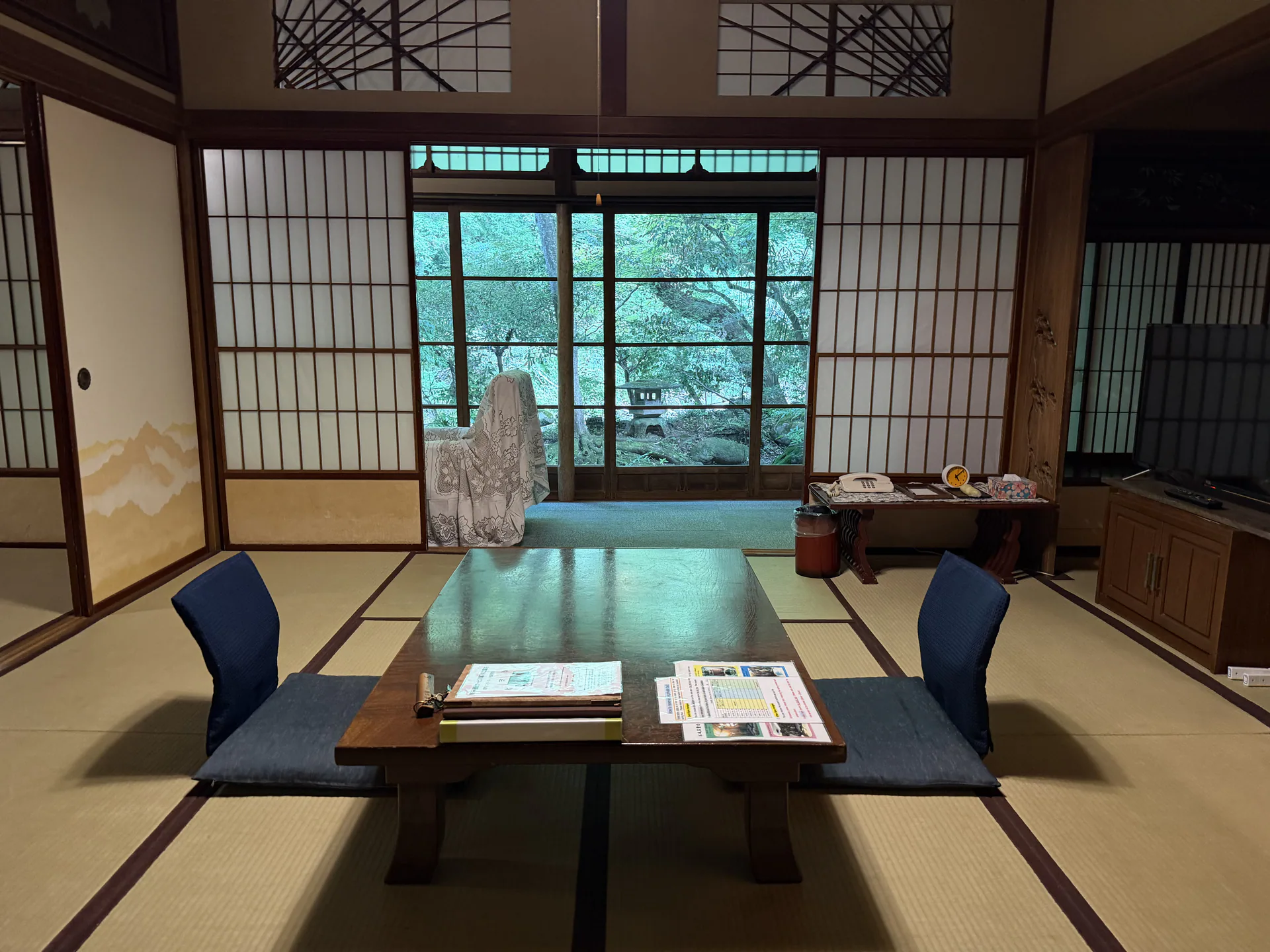
- Fukuzumiro, in Tōnosawa (Hakone). It’s an old wooden building by the river.
What a night looks like, from check-in to checkout
Step 1: Arrival and tea
around 4 to 5 p.m.
Both ryokans served me tea and a sweet as soon as I arrived. At the Maruei it was matcha with a small cake. At the Fukuzumiro it was iced green tea and a wagashi wrapped in a bamboo leaf, on the gallery facing the garden.
You take your shoes off at the entrance, and the slippers stop at the edge of the tatami.
Step 2: The room and the yukata
The room has a low table, floor cushions and an alcove called the tokonoma, with a calligraphy scroll. At the Maruei a picture window looked out on the lake, while at the Fukuzumiro it looked out on the garden.
The yukata is a cotton robe, and it’s waiting for you folded in the room. You wear it to dinner, to the bath and to bed.
Step 3: The bath
before or after dinner
You bathe naked, after washing yourself on a stool at a faucet. Then you get into the clean water, which is for relaxing, not for washing.
At Lake Kawaguchi my room had a private outdoor bath on the balcony, facing the lake. In Hakone my room had its own bath, and I also booked a round bath made of stone and brass, fed by a bamboo pipe, in the evening and again when I woke up.
Step 4: The kaiseki dinner
6:30 p.m. in Hakone, 7 p.m. at Lake Kawaguchi
Dinner is kaiseki, a series of small dishes brought to your room. At the Fukuzumiro there was sashimi, wagyu beef, shellfish, tempura and a simmered fish. At the Maruei you grilled the wagyu yourself on a hot stone, and the menu was in English.
You set the dinner time when you check in, and the meal takes up the whole evening.
Step 5: The futons
at night
After dinner the table is put away and the futons are laid out on the tatami. The mattress is thin and the pillow is firm.
Step 6: Breakfast and checkout
around 7 a.m.
Breakfast is served in the morning at a set time. In Hakone it was included in the price, but I left at 7 a.m., before it was served, to get to Gora early. So I never tried it.
Modern or old: how my two stays compared
| Maruei (Lake Kawaguchi) | Fukuzumiro (Hakone) | |
|---|---|---|
| Building | modern | wood, the inn moved in around 1910 |
| View | the lake, and Mount Fuji from the roof | the garden and the river |
| Bath | private, on the balcony | private and round, in stone |
| Dinner | wagyu on a hot stone, in your room | classic kaiseki, in your room |
| What you give up | the feel of an old building | the view, at the bottom of the gorge |
You can book both on Booking.com: the Wakakusa no Yado Maruei ryokan and the Fukuzumiro ryokan.
What I found
I spent one night at the Maruei and one night at the Fukuzumiro.
Both evenings revolved around dinner and the bath, and I didn’t go back out after dinner. In Hakone I left too early for breakfast.
One night is enough to get the idea, but two nights in the same place give you time for the bath without rushing.
Mistakes to avoid
- Arriving late. At both of my ryokans dinner was served between 6:30 and 7 p.m.
- Leaving before breakfast. You’ve paid for it, and I missed it in Hakone by leaving at 7 a.m.
- Picking an old ryokan for the view. The Fukuzumiro sits at the bottom of a gorge and doesn’t have one.
- Getting into the bath before washing. You wash first, sitting at the faucet.
FAQ
What is a ryokan?
A traditional Japanese inn: a tatami room, futons and a yukata, usually with dinner and breakfast included, and often a hot-water bath.
Is dinner included at a ryokan?
Usually, yes, and it’s served in your room or a private dining room. At both of the ryokans where I stayed, the kaiseki dinner was served in my room.
How does the bath work at a ryokan?
You wash first, sitting at a faucet, then get into the hot water naked. Both of my ryokans had a private bath.