
Climbing
Mount Fuji climbing gear
Mount Fuji climbing gear: the official list of essentials and extras, the three items checked at the Yoshida Trail gate, where to buy gear locally and why you need cash.
On this page
The official gear list for climbing Mount Fuji asks for over-the-ankle hiking boots, a two-piece rain suit, warm layers, a headlamp, water and cash. On the Yoshida Trail, part of that gear is checked at the gate. I didn’t have waterproof rain pants, so I had to buy a pair on the spot before I could start.
At a glance
- Checked at the gate
- 3 itemsboots, a two-piece rain suit, warm clothes
- Essentials
- 14 itemson the official list
- Pack
- about 30 Lwith 1 to 2 L of water
- Payment
- cashnone of the shops I stopped at took cards
What’s checked at the Yoshida Trail gate
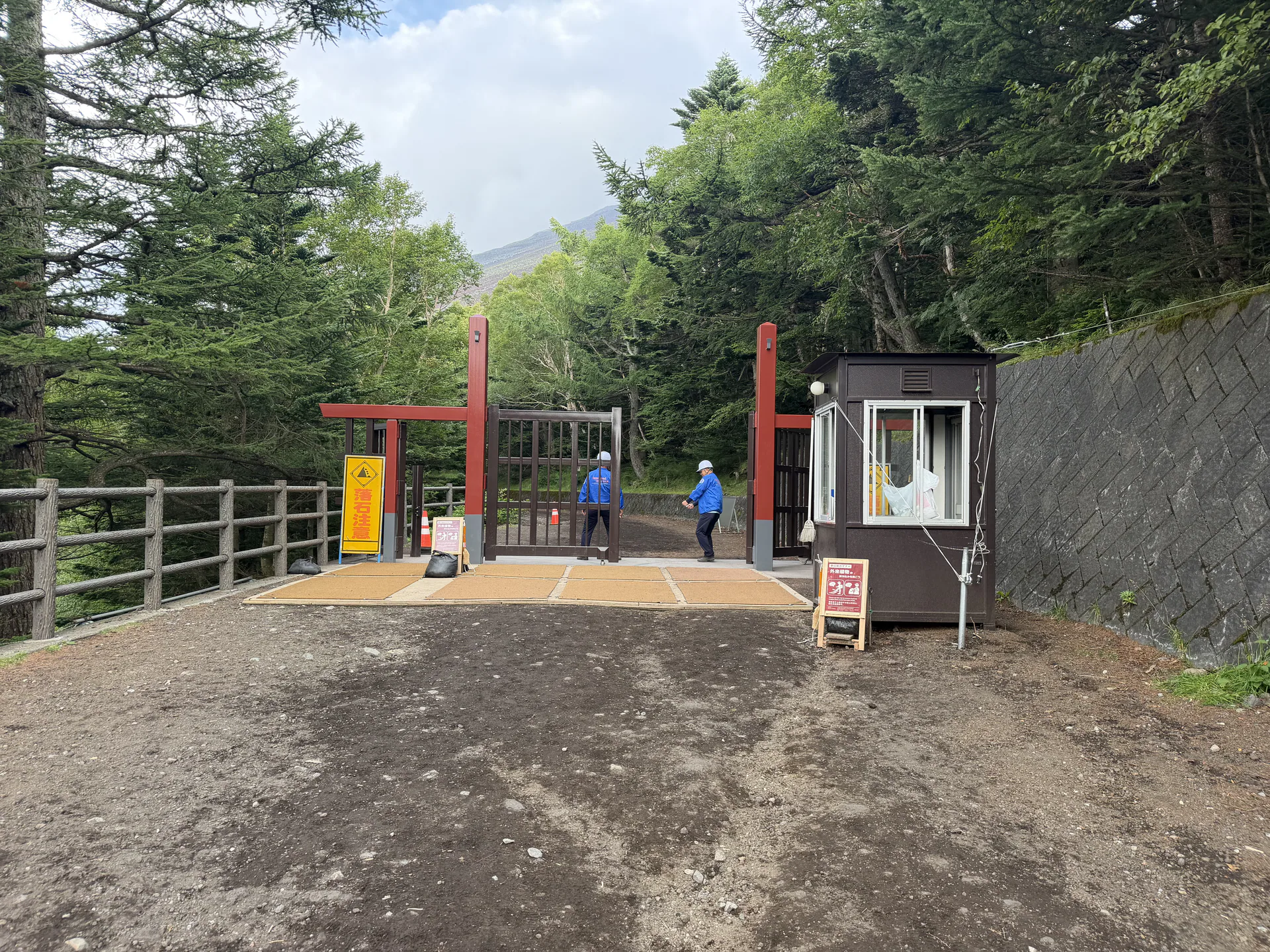
At the start of the Yoshida Trail, at the Subaru Line 5th Station, staff check every hiker’s gear: warm layers, a separate rain jacket and rain pants, and hiking boots. If you’re missing any of the three, they won’t let you through.
That’s what happened to me. I had no waterproof rain pants, so I bought a pair at the Mount Fuji Miharashi shop at the 5th Station, twenty minutes before setting off. They cost me ¥9,600.
The check is a Yamanashi Prefecture rule, since the prefecture runs the Yoshida Trail. The official list itself applies to all four trails, and you’ll find it on the gear page of the official Mount Fuji climbing site, which separates the essentials from the recommended items.
Where to buy gear near Mount Fuji
You can also get this gear at the foot of the mountain. The day before the climb I stopped at Sports Depo, a big sporting goods store from the Alpen group in Fujikawaguchiko. I bought a cap there, plus a neck gaiter I never ended up wearing.
In the store a poster flags the products recommended for the climb with a sticker. It hangs next to the official poster with the season’s rules.
At the 5th Station the Mount Fuji Miharashi shop also sells what you need to complete your outfit. That’s where I bought my rain pants at the last minute.
These stores carry Japanese outdoor brands at local prices. There’s mont-bell, the mountain brand from Osaka, and Asics, from Kobe, whose trail range includes the Trabuco shoes I wore. The North Face is sold in Japan under license by Goldwin, a Japanese company.
In stores that display a tax-free sign, tourists get the consumption tax back from ¥5,000 in pre-tax purchases per store per day, refunded when you leave Japan after a customs check, since November 1, 2026.
You’ll also find places to gear up near each stop around the mountain:
- in Fujiyoshida, the mont-bell store at the Michi-no-eki Fujiyoshida roadside station, and a Workman store, a Japanese budget workwear chain that also sells rain gear;
- in Fujikawaguchiko, besides Sports Depo, LaMont rents out climbing gear;
- in Gotemba, The North Face store at the Gotemba Premium Outlets mall;
- in Fujinomiya, a Workman Plus store.
Map of outdoor stores around Mount Fuji
Loading map…
- Sports Depo FujikawaguchikoBig sporting goods store from the Alpen group, with a hiking section. In the Forest Mall.
- LaMont gear rentalClimbing gear rental in Fujikawaguchiko.
- mont-bell FujiyoshidaStore of the Japanese mountain brand, at the Michi-no-eki Fujiyoshida roadside station.
- Workman Fujiyoshida MatsuyamaBudget workwear and outdoor chain, including rain gear.
- Mount Fuji Miharashi shopAt the Subaru Line 5th Station, at the start of the Yoshida Trail.
- The North Face, Gotemba Premium OutletsBrand store in the Gotemba outlet mall.
- Workman Plus Fujinomiya MiyaharaBudget workwear and outdoor clothing, north of central Fujinomiya.
What to bring, item by item
Step 1: The three items checked at the gate
- Over-the-ankle hiking boots. The trail alternates between rock, steps and volcanic scree that rolls under your feet. Waterproof boots that come up over the ankle hold it in place on the way down.
- Waterproof rain pants, not water-resistant ones. That’s the item I was missing. Rain pants go on over your hiking pants.
- A waterproof jacket, separate from the pants. A rain jacket does the job, but a windbreaker that’s only water-resistant may not pass the check.
- Warm clothes. The official list mentions a fleece, a down jacket and gloves. A fleece packs down easily in your bag.
I set off in a T-shirt under a clear sky and added a sweater in the clouds. At the top, in the sun, the T-shirt and sweater were enough. That only holds for a dry day, though, and in rain and wind the same clothes won’t do.
Your boots matter most, because the ground keeps changing along the trail. On the way up you climb rock steps, then around 2,900 m steeper rocky sections fitted with chains. The way down is the opposite: long switchbacks of red soil covered in scree, small volcanic gravel that rolls under your feet, all the way to the 5th Station.
The official climbing site warns that the Yoshida and Subashiri descent can be very slippery between Hon-hachigōme and the Shita-Edoya hut. It recommends over-the-ankle boots that support your ankle and advises against sneakers, which slip and don’t protect it. Wear new boots for a few days before you leave, or they may give you blisters.
I went up in low-cut trail running shoes, Asics Trabuco 14, and they passed the gate check. On the way down they held up in the scree, with hiking pants long enough to cover the top of the shoe. If you’d rather follow the official advice, every major hiking brand makes waterproof over-the-ankle boots.
Step 2: The rest of the essentials
The official list adds these items, for all four trails:
- a headlamp and spare batteries, even for a day climb;
- a pack of about 30 L;
- 1 to 2 L of water and some snacks;
- trash bags to carry out your garbage;
- a hat, sunglasses and sunscreen;
- a map, trekking poles and a first aid kit.
The trekking poles on the list are regular hiking poles, the kind sold in any sporting goods store. The official site says they help you keep your balance, especially on the way down.
Flying with them depends on the airport and the airline. In the US, TSA, the airport security agency, on its page about hiking poles, allows blunt-tipped poles in carry-on bags but not sharp-tipped ones, and some airlines still refuse them in the cabin. The rules on the flight home are set in Japan, so the simplest is to pack folding poles in your checked bag, or buy a pair locally at a store like Sports Depo.
Don’t confuse them with the kongō-zue, the wooden stick sold at the 5th Station. That one’s mainly a souvenir, which you get branded with stamps at the mountain huts, and it doesn’t replace a pair of trekking poles.
I bought one anyway. Huts along the trail brand it with a hot iron for a fee: at the Goraikō-kan, around 3,450 m, it was ¥500 for the hut's two stamps.
For food, I brought very sweet energy bars and gels from home. The huts also sell food, for cash.
Step 3: Cash
The official list asks for cash, including ¥100 coins. None of the shops I stopped at took cards.
- The restrooms aren’t free. At the 6th Station a “Tip for toilet” notice on each door asks for a contribution in coins.
- Emergency water costs money. At the 6th Station it sells for ¥600 a bottle, for descending climbers only.
- So does lunch at the top. At the huts on the crater rim: ¥1,300 for a bowl of udon, ¥600 for a hot drink.
On the Yoshida Trail descent, the last shop is around 3,270 m. Its sign warns there’s no water after that point, and it took me about 2.5 hours to get from there to the 5th Station.
Step 4: Recommended extras
The official list also recommends, among other things, a helmet, a dust mask and a power bank.
The dust stays with you all the way down. Some hikers wear gaiters, but long pants that covered the top of my shoes were enough.
 Read nextThe Yoshida Trail up Mount FujiThe Yoshida Trail in one day: shuttle and parking for the Fuji Subaru Line 5th Station, the gear check at the gate, real times from a GPS watch and mistakes to avoid.
Mistakes to avoid
- Showing up with water-resistant pants. The rule calls for real rain pants, and pants that are only water-resistant may get turned away at the gate on the Yoshida Trail. Buying a pair on the spot costs ¥9,600.
- Counting on a windbreaker. The jacket has to be waterproof and separate from the pants.
- Leaving without coins. Restrooms and shops on the trail take cash only.
- Counting on water all the way down. On the Yoshida Trail descent, nothing is sold below about 3,270 m.
- Judging your clothes by a dry day. My T-shirt and sweater were enough in good weather, but they wouldn’t be in the rain.
What I found
The gear check at the Yoshida Trail gate was for real. I didn’t have waterproof rain pants, so I bought a pair at the 5th Station right before starting.
In dry weather a T-shirt and a sweater were enough for me all the way to the crater rim.
I couldn’t pay by card anywhere on the trail, and the restrooms took coins.
FAQ
What gear is required to climb Mount Fuji?
At the Yoshida Trail gate you have to show hiking boots, a separate rain jacket and rain pants, and warm clothes. Without them, you can’t go through. The official list adds a headlamp, water, cash and sun protection for all four trails.
Are water-resistant pants enough for the gear check?
No. On the day I climbed, pants that were only water-resistant weren’t enough, and I had to buy waterproof rain pants at the shop at the Subaru Line 5th Station.
Can you buy gear at the 5th Station?
Yes, at the Subaru Line 5th Station. I bought rain pants there, plus the kongō-zue, a wooden souvenir stick. You can also find gear at the Sports Depo sporting goods store in Fujikawaguchiko.
Do you need a headlamp for a day climb?
It’s on the official list of essentials, even for a day climb. If you spend the night in a hut and head up for the sunrise, you hike in the dark.
How much water should you bring to climb Mount Fuji?
The official list recommends 1 to 2 liters. You can buy water at the huts on the way up, but on the Yoshida Trail descent the last shop is around 3,270 m.