
Seeing and photographing
Visiting Chureito Pagoda
Chureito Pagoda in Arakurayama Sengen Park, Fujiyoshida: the 398 steps, paid parking, the train to Shimoyoshida, crowds and the Mount Fuji view.
On this page
- Map of Arakurayama Sengen Park, from the parking lot to the station
- The view of the pagoda and Mount Fuji
- The 398 steps of the Sakuya-hime stairway
- What is the Chureito Pagoda?
- Parking: fees and how to pay
- By train or bus from Kawaguchiko
- Day trip from Tokyo
- Where to stay nearby
- At the park: map, restrooms and wildlife
- Mistakes to avoid
Chureito Pagoda sits above Fujiyoshida, facing Mount Fuji, in Arakurayama Sengen Park. You get up to it by a 398-step stairway from Arakura Fuji Sengen Shrine. The park is free and open 24 hours a day, year-round. Early in the morning I saw about ten people there, but spring and fall crowds are nothing like that.
At a glance
- Entry
- freeyou only pay for parking
- Climb
- 398 stepsunder 10 min from the shrine to the pagoda
- Time needed
- about 30 minparking lot to parking lot
- Closest station
- ShimoyoshidaFujikyu line
Chureito Pagoda: Fujiyoshida, Honcho Street and Oshino HakkaiMap of Arakurayama Sengen Park, from the parking lot to the station
The parking lot, the shrine and the stairway are all on the same side of the park, while Shimoyoshida Station is down the hill to the east.
Loading map…
- Municipal Parking Lot No. 1Paid, at the foot of the shrine. Closed during the 2026 cherry blossom season.
- Arakura Fuji Sengen ShrineStart of the 398-step staircase.
- Chureito Pagoda and deckThe view of the pagoda and Mount Fuji is from the deck above it.
- Shimoyoshida StationFujikyu line. The closest station to the park.
- Kawaguchiko StationEnd of the Fujikyu line and bus terminal.
- Hotel Fuji ToriigateI stayed here one night. Near Fujisan Station.
The view of the pagoda and Mount Fuji
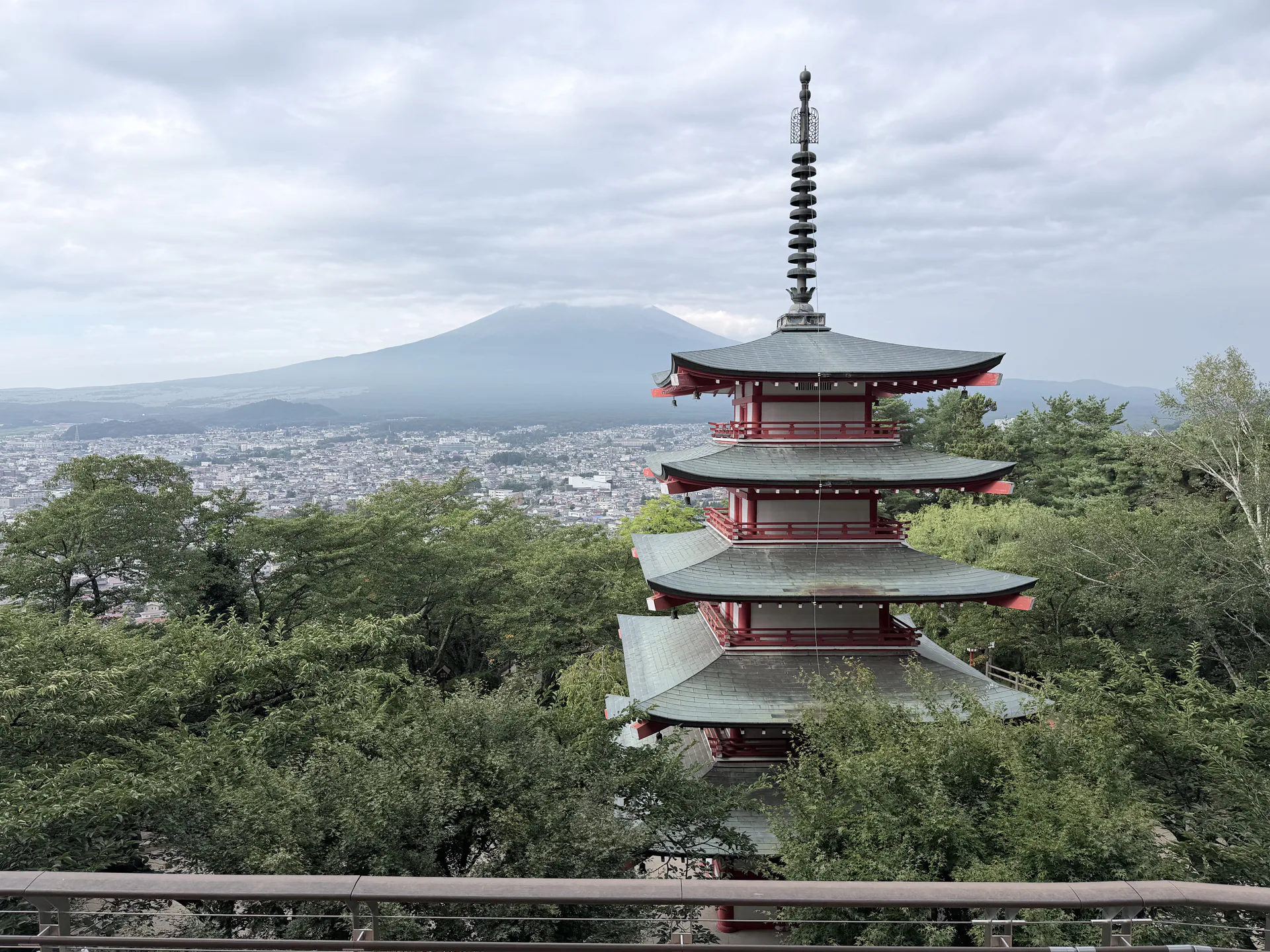
The famous shot isn’t taken at the foot of the pagoda. You take it from the observation deck a few meters above, with the pagoda in the foreground, the town of Fujiyoshida in the middle and Mount Fuji behind.
The morning I was there, the mountain was visible but hazy, with no snow. Clouds kept catching the summit, and the sky stayed gray the whole time.
The wooden deck was enlarged thanks to 8,652 donors, according to the plaque the city put up in February 2022. Around 7 a.m. there was room everywhere.
The 398 steps of the Sakuya-hime stairway
The climb starts at Arakura Fuji Sengen Shrine, at the bottom of the park. The stairway is called the Sakuya-hime stairway, and it has 398 steps: the number is carved on the stone marker at the start.
It goes up under maple trees, with a handrail on each side, and it’s easy if you take it at your own pace. It took me under 10 minutes from the shrine to the pagoda, photo stops included.
On the way back, stop at the shrine’s big vermilion torii. It’s below the pagoda and lines up with Mount Fuji.
What is the Chureito Pagoda?
The five-story pagoda is a war memorial. The city of Fujiyoshida finished it in 1962 in memory of its residents who died in war. You can’t go inside, so you just walk around it on the paved plaza.
Parking: fees and how to pay
I drove and parked at Municipal Parking Lot No. 1, at the foot of the shrine. It costs ¥1,500 for up to 6 hours, and the fee starts over after that. The lot has 88 spaces.
You pay at one of the two machines before you go back to your car, with the ticket you took at the entrance. The machine took credit cards.
The city runs three more paid lots around the park. The official Fujiyoshida tourism guide, which lists every lot with its fees and number of spaces, has the details. Lot No. 1 was closed from April 1 to April 19, 2026, during the cherry blossoms.
By train or bus from Kawaguchiko
Without a car, the easiest way is the Fujikyu line train to Shimoyoshida Station. A ticket from Kawaguchiko costs ¥310. Shimoyoshida is the fourth stop after Kawaguchiko, heading toward Otsuki.
Train times are on the Fujikyu Railway site, on the Shimoyoshida timetable page (in Japanese).
From the station to the pagoda the city gives about 25 minutes on foot, stairway included.
As for buses, none of the Kawaguchiko sightseeing lines (Red, Green and Blue Line) go to the pagoda. Their passes are sold at machines in the bus terminal, but they won’t get you there. Fujiyoshida’s Town Sneaker city bus does stop at Shimoyoshida Station, for ¥100 per ride.
Day trip from Tokyo
A day trip from Tokyo is easy to do, since the visit itself only takes half an hour. There are three ways to do it, from the most direct to the most organized.
- The Fuji Excursion direct train. It leaves from Shinjuku and stops at Shimoyoshida, in about 1 hour 45 minutes. The ticket is ¥4,010 including the limited express fee, four round trips a day, plus one in some seasons. With so few trains a day, I’d pick both the outbound and the return train before you leave.
- The express bus. Some Shinjuku to Kawaguchiko buses stop at “Chuo Expressway Shimoyoshida”. The stop is on the expressway, about 10 minutes on foot from Shimoyoshida Station.
- A bus tour. Day tours from Tokyo combine the pagoda, Lake Kawaguchi and Oshino Hakkai. I didn’t take one.
This one has the pagoda on its itinerary: a guided day trip from Tokyo on GetYourGuide.
Check the tour description to make sure the pagoda is included and not optional. On several tours it’s optional or costs extra.
Where to stay nearby
I stayed the night before at the Hotel Fuji Toriigate, in Fujiyoshida, near Fujisan Station. It was about a 10-minute drive to the pagoda parking lot, with a stop at the big bronze torii on the main street.
My room had two low beds on a platform, a wooden lattice window and a private bathroom with a toilet. The hotel also has a rooftop terrace facing Mount Fuji, but the night I stayed, the mountain was in the clouds.
You can book it on Booking.com: see the Hotel Fuji Toriigate on Booking.com.
At the park: map, restrooms and wildlife
A park map near the pagoda shows the stairway, the deck, the parking lot and the path to the station. There are wheelchair-accessible restrooms on the plaza and more near the shrine.
Signs along the climb ask you not to feed the monkeys and warn that bears live in the area. I didn’t see either.
What I found
I spent about half an hour there, on a weekday morning around 7 a.m. I saw about ten people, there was no wait for the deck, and the parking lot was nearly empty.
Mount Fuji was visible but hazy, with no snow. The shot with cherry blossoms and a snowy summit is a spring shot: in summer, expect a gray mountain that’s often in the clouds.
The visit is short. Once you’ve taken in the view from the deck, there’s nothing else to do in the park, so plan on half an hour and go early.
Mistakes to avoid
- Showing up in peak season unprepared. The city expects heavy crowds during the cherry blossom season, from late March to early May, and the autumn leaves, from late October to early December. At the peak of the cherry blossoms, it counted over 10,000 visitors a day, with a 1 to 3 hour wait for the observation deck.
- Counting on the parking lot in spring. In 2026, Lot No. 1 was closed from April 1 to April 19, 2026. Taking the train to Shimoyoshida gets around that.
- Buying a sightseeing bus pass to get there. The Red, Green and Blue Lines from Kawaguchiko don’t go to the pagoda.
- Driving up to the pagoda. The city asks visitors not to use the service road up to the plaza, so park at the bottom.
In 2026, the city canceled its cherry blossom festival in the park. Its press release from Fujiyoshida City Hall announcing the cancellation (in Japanese) cites people walking into residents’ gardens and schoolchildren being pushed on the sidewalks. The streets around the park are residential, so stick to the main roads.
FAQ
Is Chureito Pagoda free?
Yes. I didn’t pay anything to get into Arakurayama Sengen Park. Only the parking lot charges a fee.
How many steps are there to Chureito Pagoda?
The Sakuya-hime stairway has 398 steps, according to the marker at the bottom. It took me under 10 minutes from the shrine to the pagoda, photo stops included.
What is the closest station to Chureito Pagoda?
Shimoyoshida Station, on the Fujikyu line between Otsuki and Kawaguchiko. The city gives about 25 minutes on foot to the pagoda, stairway included.
When is Chureito Pagoda most crowded?
During the cherry blossoms, from late March to early May, and the autumn leaves, from late October to early December, according to the city of Fujiyoshida. On an August morning I saw about ten people.
Can you see Mount Fuji from Chureito Pagoda in summer?
The morning I was there, in summer, Mount Fuji was visible but hazy, with no snow, and the summit kept going in and out of the clouds.