
Seeing and photographing
Fujiyoshida and Honcho Street
Fujiyoshida at the foot of Mount Fuji: the big bronze torii, Honcho Street and the Gekkoji arcade, Chureito Pagoda, a hotel, a yakitori spot and how to get there.
On this page
Fujiyoshida is the town at the northern foot of Mount Fuji, east of Lake Kawaguchi. People come for Chureito Pagoda and for Honcho Street, where Mount Fuji rises at the end of the street behind the power lines. I stayed one night in summer: early in the morning Mount Fuji showed behind the big torii, but by around 1 p.m. it had disappeared into the clouds.
At a glance
- For Mount Fuji
- early morninghidden around 1 p.m. in summer
- Honcho Street
- freeno photos from the roadway
- Chureito Pagoda
- 1 km awayfrom Honcho Street, according to the sign
- From Kawaguchiko
- Fujikyu train¥310 to Shimoyoshida
Map of Fujiyoshida and Chureito Pagoda
Loading map…
- Hotel Fuji ToriigateI stayed here one night. Near Fujisan Station.
- Kanadorii gateBig bronze torii lined up with Mount Fuji.
- Yakitori YamaKamiyoshida 2-2-7. Approximate location.
- Honcho Street
- Komuro Sengen Shrine
- Miyagawabashi parkingPaid parking near Honcho Street.
- Shimoyoshida StationFujikyu line. The closest station to the park.
- Arakura Fuji Sengen ShrineStart of the 398-step staircase.
- Chureito Pagoda and deckThe view of the pagoda and Mount Fuji is from the deck above it.
- Municipal Parking Lot No. 1Paid, at the foot of the shrine. Closed during the 2026 cherry blossom season.
The big bronze torii lined up with Mount Fuji
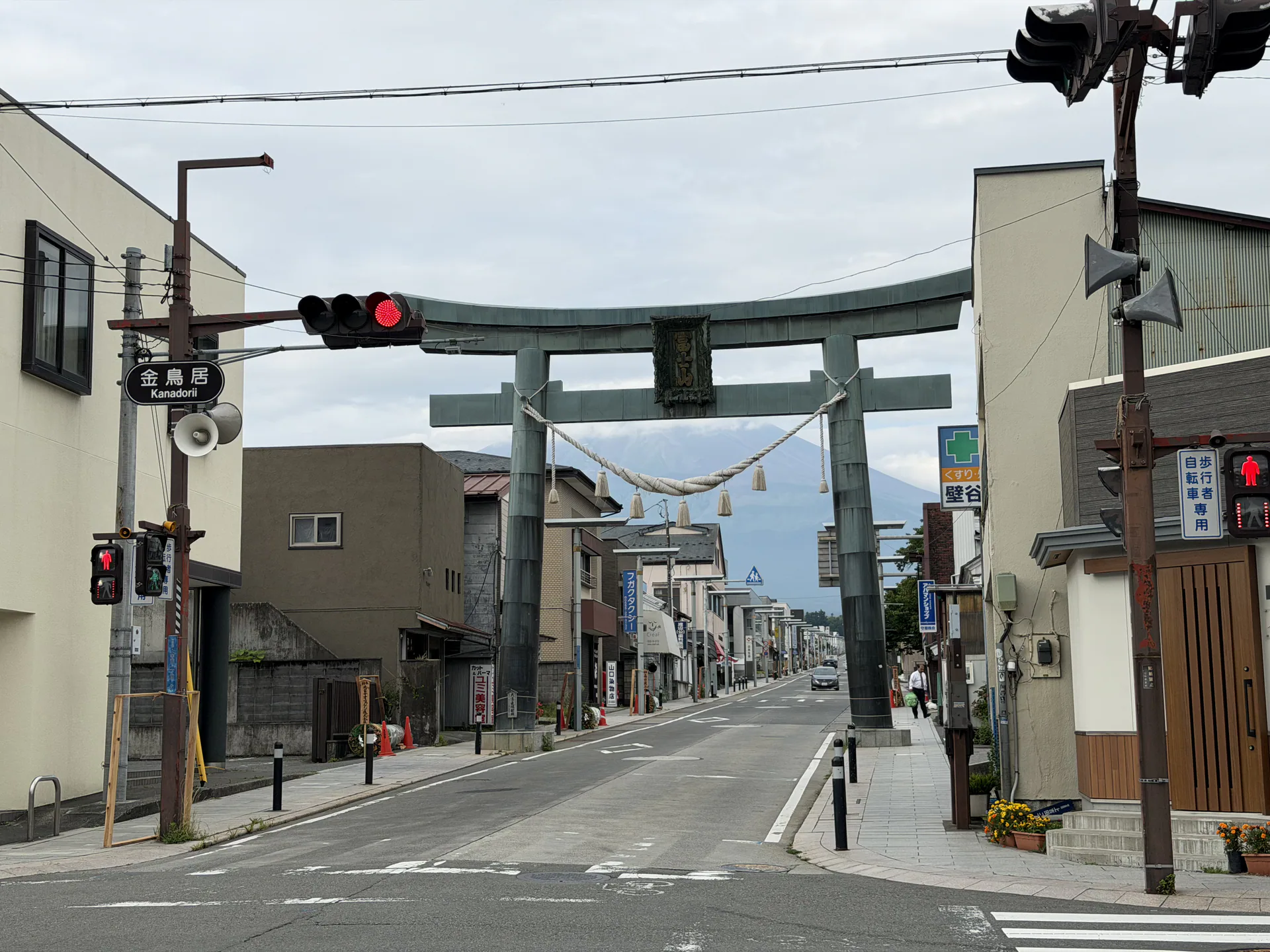
South of the town center, the main street runs under a big green bronze torii called the Kanadorii. A sign with its name hangs from the traffic light at the intersection. The torii faces Mount Fuji, which rises straight ahead at the end of the street.
I walked over early in the morning from my hotel, which is just around the corner. Mount Fuji was visible but hazy under a gray sky. A car went by now and then and the intersection has traffic lights, so you take your photos from the sidewalk.
Honcho Street and the Gekkoji arcade
Farther north the same street becomes Honcho Street (Honchō-dōri). It’s lined with low shops under striped awnings and streetlights shaped like lanterns. This is where the shot of Mount Fuji at the end of the street, under the power lines, comes from, the one you see all over social media.
I didn’t get that shot: around 1 p.m. Mount Fuji was completely hidden by clouds. The street was nearly empty, with a few people walking by and the odd car.
The official Fujiyoshida tourism guide, which has a page on Honcho Street and how to photograph it, asks visitors not to take photos from the roadway because it’s dangerous. People live and work on this street, so the guide also asks you to be considerate.
The storefronts are a mix of old wooden merchant houses, small glass-fronted shops and a few newer businesses, like a secondhand shop.
Off one side of the street is the Gekkoji Daimon arcade, a pedestrian shopping street you’ll spot by its green gateway. Between the two streets, narrow alleys run between sheet-metal and wooden walls.
Komuro Sengen Shrine
A few minutes’ walk from Honcho Street, a stone-paved path leads to Komuro Sengen Shrine. It goes under a stone torii, then under strings of red and white lanterns. There was nobody at the entrance.
Chureito Pagoda, above the town
Chureito Pagoda looks down on Fujiyoshida from Arakurayama Sengen Park. A sign on Honcho Street puts it 1 km away. You walk up a 398-step stairway, and the park is free and open 24 hours a day, year-round.
I went early in the morning, before Honcho Street. That’s the order I’d stick to in summer, when Mount Fuji hides from late morning on. The Chureito Pagoda page covers access, parking and crowds.
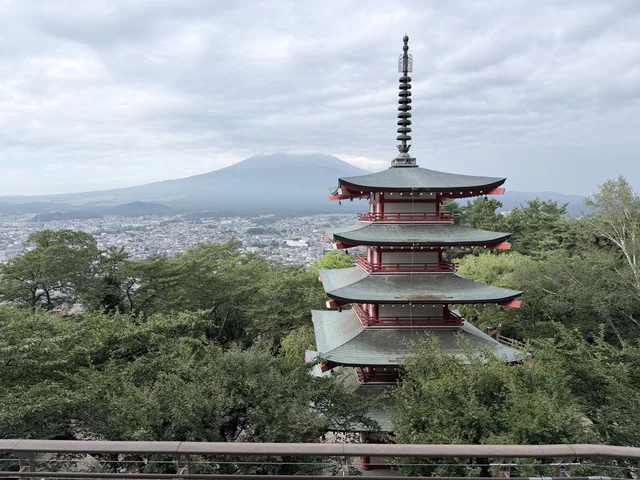 Read nextVisiting Chureito PagodaChureito Pagoda in Arakurayama Sengen Park, Fujiyoshida: the 398 steps, paid parking, the train to Shimoyoshida, crowds and the Mount Fuji view.
Where to stay: Hotel Fuji Toriigate
I stayed at the Hotel Fuji Toriigate, near Fujisan Station and a short walk from the big bronze torii. My room had two low beds on a platform and a private bathroom with a toilet.
The hotel has a rooftop terrace facing Mount Fuji, but the night I stayed, the mountain never came out of the clouds. A big common room doubles as the breakfast room.
In front of the hotel, a small red shrine between two stone lanterns is lit up at night. The hotel has its own parking lot.
You can book it on Booking.com: see the Hotel Fuji Toriigate on Booking.com.
Where to eat
Yama, charcoal-grilled yakitori
I had dinner at Yama, an izakaya that grills skewers over charcoal, very close to the hotel in the Kamiyoshida neighborhood. I ordered chicken thigh, house-made tsukune with salt and with sauce, gizzards and other offal, plus rice and cucumber sticks with miso.
A per-person table charge is added to the bill, as in many izakaya. I paid by credit card.
Getting to Fujiyoshida and getting around
- By train from Kawaguchiko: the Fujikyu line stops at Fujisan, Gekkōji and Shimoyoshida. A ticket to Shimoyoshida costs ¥310.
- By direct train from Tokyo: the Fuji Excursion runs from Shinjuku to Shimoyoshida in about 1 hour 45 minutes, for ¥4,010 including the limited express fee, four round trips a day, plus one in some seasons.
- By city bus: the Town Sneaker loops around the town center and stops on Honcho Street, for ¥100 per ride.
- By car, which is how I got around. At the end of Honcho Street, the sign at the Miyagawabashi South municipal parking lot read ¥200 for the first hour, then ¥100 per 30 minutes, capped at ¥1,000 for 12 hours.
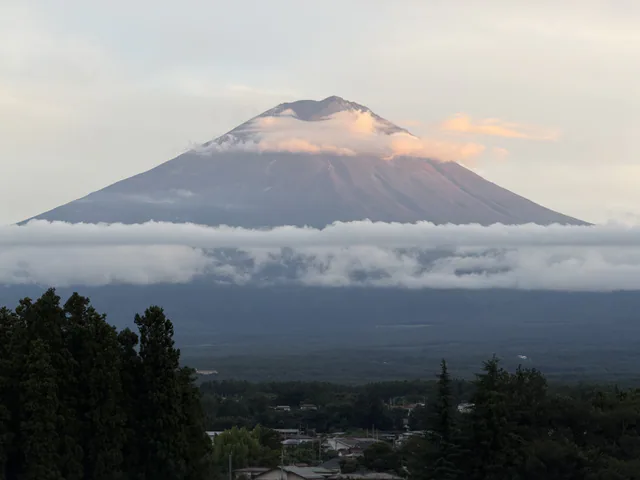 Read nextLake Kawaguchi (Kawaguchiko)Lake Kawaguchi and the town of Kawaguchiko: the Mount Tenjo ropeway, the north shore, Oishi Park, a lakeside ryokan, places to eat and how to get there by train or bus.
What I found
I spent one night in Fujiyoshida, then came back the next day in the early afternoon.
Mount Fuji was hazy but visible early in the morning behind the big torii, while around 1 p.m. it had completely disappeared from Honcho Street. In summer, I’d try for the street shot in the morning.
It took me about 20 minutes to walk Honcho Street and the arcade. Without Mount Fuji at the end of the street, the photo that brings people here doesn’t exist, and that day all that was left was a row of neighborhood shops.
Mistakes to avoid
- Coming for Honcho Street on a summer afternoon. Around 1 p.m. Mount Fuji was completely hidden.
- Taking photos from the roadway. The city specifically asks you not to, since the street is open to traffic.
- Forgetting that people live here. The official guide asks visitors to be considerate on the shopping street.
- Counting on the hotel terrace for a view of Mount Fuji. The night I was there, the mountain never came out of the clouds.
FAQ
Where do you take the Mount Fuji photo on Honcho Street?
From the sidewalk of Honcho Street, in the Honcho 2-chome shopping district, looking toward Mount Fuji at the end of the street. The city’s official guide asks visitors not to take photos from the roadway.
What time can you see Mount Fuji from Honcho Street?
In summer, early in the morning. When I was there, it was visible but hazy around 7 a.m. from the big bronze torii, and completely hidden around 1 p.m. on Honcho Street.
How do you get to Fujiyoshida from Kawaguchiko?
By train on the Fujikyu line, which stops at Fujisan, Gekkōji and Shimoyoshida stations. A ticket to Shimoyoshida costs ¥310.
How far is Chureito Pagoda from Honcho Street?
A sign on Honcho Street puts Arakurayama Sengen Park 1 km away. The pagoda is at the top of a 398-step stairway.
Where should you stay in Fujiyoshida?
I stayed at the Hotel Fuji Toriigate, near Fujisan Station and the big bronze torii, about a 10-minute drive from Chureito Pagoda.