
Activities
Owakudani, Hakone's steaming valley
Owakudani in Hakone: the ropeway from Sōunzan, the steam vents and the black eggs, with fares, opening hours and the parking lot.
On this page
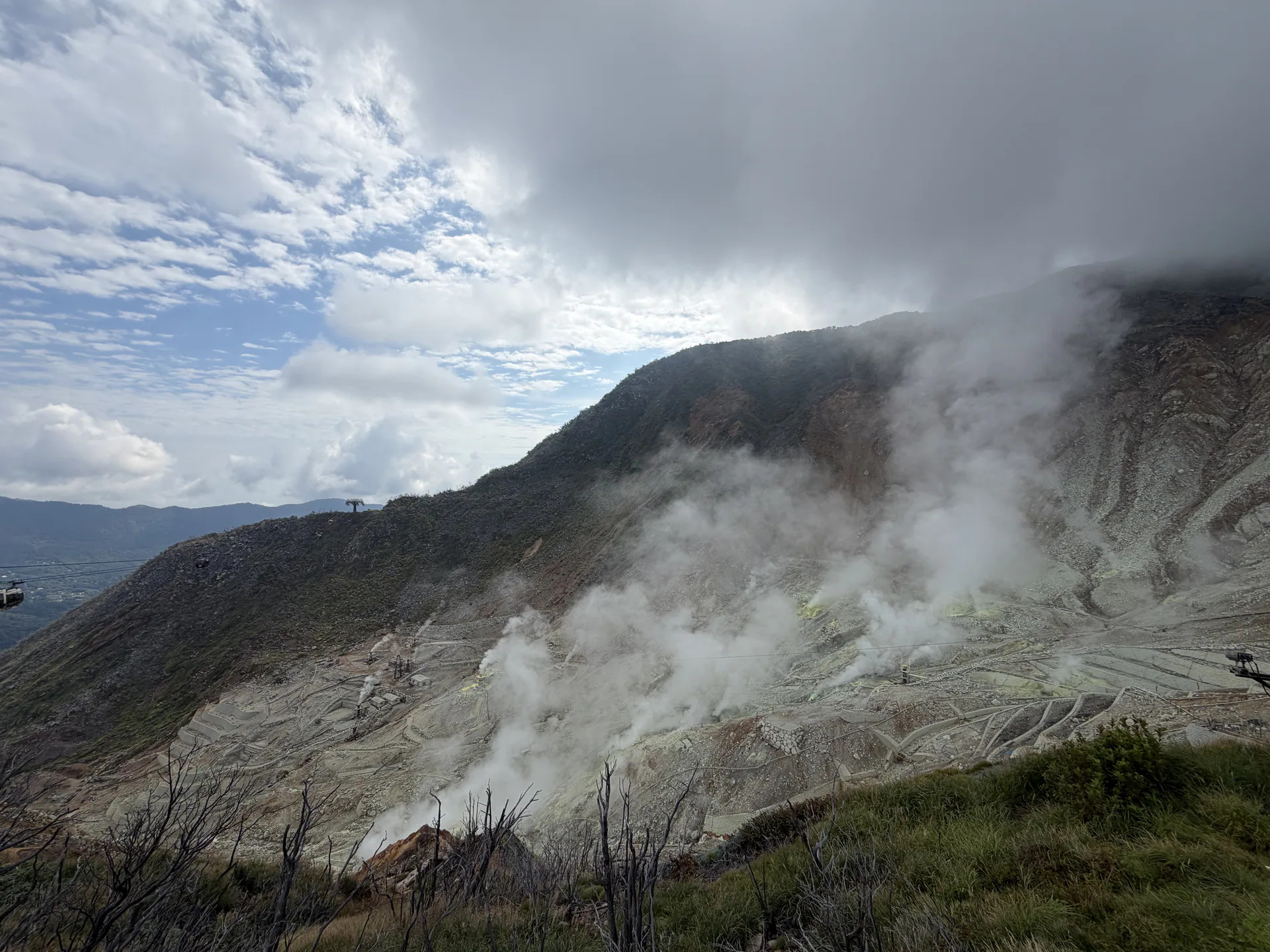
Owakudani is Hakone’s active crater, at 1,044 m. The valley steams all the time, and the thing to eat is hard-boiled eggs turned black in the spring water. You ride up on the Hakone Ropeway from Sōunzan, right over the steam vents. I went on a summer morning, under the clouds.
At a glance
- Ropeway
- ¥3,000round trip from Sōunzan
- Black eggs
- ¥500for a bag of 4
- Time at the top
- 30 mineggs and the viewpoint
- Mount Fuji
- not seenlow clouds in summer
Map of the ropeway, from Gora to Lake Ashi
Loading map…
- Gora Station541 mMountain railway and cable car to Sōunzan.
- Sounzan Station750 mCable car and ropeway.
- Owakudani1 044 mSteam vents and black eggs, by ropeway.
- Kojiri portNorth end of Lake Ashi: rowboats and swan boats. The pirate ships leave from nearby Tōgendai.
The Hakone Ropeway from Sōunzan
The Hakone Ropeway starts at Sōunzan, at the top of the Gora cable car, which costs ¥430. The ropeway has one fare for every section: ¥2,000 one way or ¥3,000 round trip.
The round-trip ticket is good for two days and lets you get off along the way. The ropeway runs 9 a.m. to 4:45 p.m. (5 p.m. at Owakudani), and when it opened I didn’t have to wait.
The ride up takes less than ten minutes. Just before the top station the gondola passes over the valley, so you see the steam vents, the yellow sulfur deposits, the pipes and the protective walls. It’s the best view of the crater.
The volcanic valley and its steam vents
Owakudani Station sits at 1,044 m according to the sign, and a terrace looks out over the steaming slope. That morning clouds covered the top of the valley, and the steam blended into the fog.
The volcanic alert was at level 1 (active volcano, normal access) when this page was last updated. It can go up without warning and close the site, and the Japan Meteorological Agency publishes it every month.
Owakudani black eggs (kuro-tamago)
Black eggs, or kuro-tamago, are the local specialty. Signs explain how they’re made: the eggs boil for about an hour in a hot-spring pool at 80°C (176°F). Minerals in the water settle on the shell and turn it black.
A bag costs ¥500 for 4 eggs, and you’re supposed to eat them within two days. A banner claims each egg adds seven years to your life. Under the black shell, though, the white and the yolk are just a regular hard-boiled egg.
In front of the black egg shop, a giant egg sculpture is the photo spot. Next door a big gift shop sells egg-shaped cookies and chocolates.
Driving up: the parking lot
Owakudani has a parking lot at the end of the road, and around 9:30 a.m. it was already almost full. A poster gave its closing time as 4:40 p.m., and cars can’t get out after that.
I went up by cable car and ropeway from Gora, which takes the parking question off the table.
The ride back down
On the way down to Sōunzan you get a clear view over Gora and its valley. The cable car then takes you back down to Gora, with a stop at Gora Park.
From Owakudani the ropeway also continues to Tōgendai, on Lake Ashi, on the same ticket.
 Read nextLake Ashi and its torii gatesLake Ashi in Hakone: the Hakone Shrine torii and its line, the hidden Kuzuryu torii, the pirate ships, Moto-Hakone and where to eat by the lake.
What I found
I took the ropeway when it opened. Half an hour at the top was enough for the eggs and the terrace.
There was no wait for the ropeway at 9 a.m. The parking lot was almost full half an hour later.
Clouds covered the top of the valley, and Mount Fuji, to the west, stayed hidden. The best part of the visit was the gondola ride over the crater, not the terrace.
Mistakes to avoid
- Counting on a view of Mount Fuji in summer. Clouds covered Owakudani from early morning.
- Driving up late in the day. The parking lot closed at 4:40 p.m., and it was almost full by 9:30 a.m.
- Planning a long visit. Unless you’re hiking, the site comes down to the terrace, the shops and the eggs, so 30 minutes is enough.
- Going without checking the volcanic alert level. If it goes up, the site can close.
FAQ
How do you get to Owakudani?
Take the Gora cable car to Sōunzan, then the Hakone Ropeway. If you drive, there’s a parking lot at the end of the road, and it closes at 4:40 p.m.
Why are the Owakudani eggs black?
They boil for about an hour in a hot-spring pool at 80°C (176°F). Minerals in the water settle on the shell and turn it black. Inside it’s a regular hard-boiled egg.
Can you see Mount Fuji from Owakudani?
On a clear day, yes. During my visit, clouds covered the top of the valley and Mount Fuji stayed hidden.