
Seeing and photographing
Lake Kawaguchi (Kawaguchiko)
Lake Kawaguchi and the town of Kawaguchiko: the Mount Tenjo ropeway, the north shore, Oishi Park, a lakeside ryokan, places to eat and how to get there by train or bus.
On this page
- Map of Kawaguchiko and the lake shores
- When can you see Mount Fuji from the lake?
- Mount Tenjo and the Panoramic Ropeway
- North shore: Fujisan Yōhaijo, a waterfall and Kawaguchi Asama Shrine
- Oishi Park
- South shore: Fuji Omuro Sengen Shrine
- Where to stay: a ryokan facing the lake
- Where to eat
- The Lawson with Mount Fuji on its roof
- Train and bus: getting here and getting around
- Mistakes to avoid
Kawaguchiko, officially Fujikawaguchiko, is the town on Lake Kawaguchi, just north of Mount Fuji. The main things to do are seeing the mountain above the water, riding the ropeway up Mount Tenjo and spending a night in a ryokan facing the lake. I spent three half-days there in summer, but Mount Fuji was only clear one evening and one morning.
At a glance
- From Tokyo
- about 2 hoursdirect train or express bus
- Ropeway
- ¥1,000round trip, 3 minutes up
- Mount Fuji in August
- early or at sunsethazy from mid-morning on
- Where to stay
- south shorerooms facing the lake, Mount Fuji from the roof
Lake Kawaguchi: where to see Mount Fuji from KawaguchikoMap of Kawaguchiko and the lake shores
Loading map…
- Kawaguchiko StationEnd of the Fujikyu line and bus terminal.
- Panoramic Ropeway (lower station)Three minutes to the top.
- Mount Tenjo summitThe lake to the north, Mount Fuji to the south.
- Fujisan Yohaijo toriiPhotos limited to 3 minutes per group.
- Haha-no-Shirataki falls
- Kawaguchi Asama ShrineWorld Heritage site, 1,200-year-old cedars.
- Oishi ParkNorth shore. Kochia, lavender, Mount Fuji across the lake.
- Fuji Omuro Sengen ShrineSouth shore. World Heritage site.
- Wakakusa no Yado Maruei ryokanI stayed here one night. Mount Fuji viewing deck on the roof.
- Kai Rikyu (yakiniku)Yakiniku: you grill wagyu beef yourself at the table.
- Cisco CoffeeCafé in a white wooden house, south shore.
- Mt. Fuji PancakeSoufflé pancakes, near the station.
- Koshuya (gyukatsu)Breaded beef, finished on a small hot stone.
- Tsunagaru CafeFood truck near the Yōhaijo, with a deck above the lake.
- Marusan BakeryBakery, melon bread to go, south of the station.
- Hōtō Fudō (hōtō noodles)Hōtō noodles in an iron pot, across from the station.
When can you see Mount Fuji from the lake?
Mount Fuji rises south of the lake. From the north shore it stands right above the water, but from the south shore it’s behind you and you have to get up high to see it. I stayed on the south shore, in a ryokan with a viewing deck on the roof.
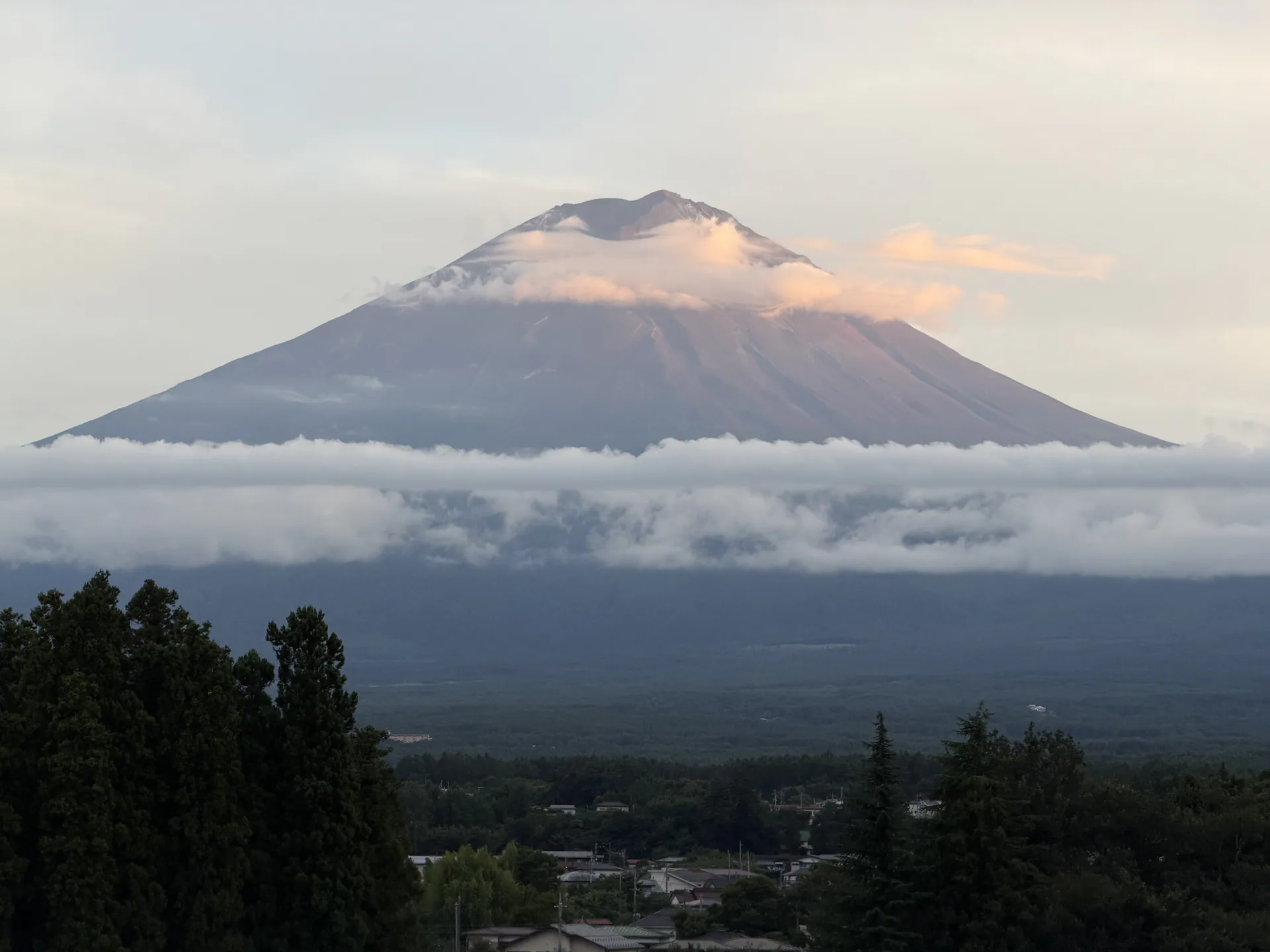
The first evening, around 6:20 p.m., the summit cleared. A sea of clouds sat halfway up the slopes and the top turned pink. At 7 a.m. the next day it was still sharp from the road.
After that I never saw anything like it again. On the following days it was hazy by around 9 a.m. from Mount Tenjo, hidden half an hour later at the Yōhaijo, and barely visible at noon from Oishi Park. In summer, aim for sunrise and sunset.
Lake Kawaguchi is one of the Fuji Five Lakes. It covers 5.7 km² with 21 km of shoreline, according to the Fujikawaguchiko town website, on its page about the lakes (in Japanese). A bridge cuts across it on the east side.
Mount Tenjo and the Panoramic Ropeway
The Mt. Fuji Panoramic Ropeway leaves from the east shore, next to the boat pier, and takes three minutes to reach the top of Mount Tenjo. A ticket costs ¥1,000 round trip, and they take credit cards.
The sign at the entrance said 8 a.m. to 6 p.m., last ride down at 6:20 p.m., and I rode up around 8:40 a.m. The official ropeway site, on its fares and hours page, gives 8:30 a.m. as the opening time, so check before you plan an early ride. Another sign warns that there’s no parking for the ropeway. The site points you to a public lot nearby.
On the way up you look down on the lake, the town and the bridge. At the top the lake is on one side, to the north, and Mount Fuji on the other, to the south. Early in the morning there were very few people, but the mountain was already hazy.
The top has red torii, a small rabbit shrine, a swing and binoculars. A trail heads off toward Mount Mitsutoge, signposted at 6 hours round trip.
North shore: Fujisan Yōhaijo, a waterfall and Kawaguchi Asama Shrine
Above the north shore, three sites sit within a kilometer of each other. You need a car, or a bus ride followed by a walk.
Fujisan Yōhaijo is a lawn with tall red torii, lined up to frame Mount Fuji. That morning the mountain was in the clouds, so all I got was the torii. A sign limits photos to 3 minutes per group. The shrine next door points out that the site doesn’t belong to it.
A little farther on, a path under the trees leads to the Haha-no-Shirataki waterfall, with a small shrine at the foot of the falls. Near the Yōhaijo a food truck sells coffee with a view of the lake.
Lower down, Kawaguchi Asama Shrine is a World Heritage site, listed together with Mount Fuji. Its grounds have giant cedars said to be 1,200 years old. Around 10:30 a.m. I only passed a handful of visitors there.
Oishi Park
Oishi Park runs along the north shore, facing Mount Fuji, and it’s free to get in. People come for the flowers: lavender late June to mid-July and red kochia mid to late October.
I came by around noon. The kochia were still green, and Mount Fuji was barely visible behind the clouds. In August, the park shows neither at its best.
South shore: Fuji Omuro Sengen Shrine
On the southwest shore, Fuji Omuro Sengen Shrine is also part of the World Heritage site. Its red and gold lacquered main hall used to stand on the slopes of Mount Fuji. It was moved here in 1973 and 1974.
In mid-afternoon the path to the shrine was almost empty. The wooden prayer plaques are painted with Mount Fuji.
Where to stay: a ryokan facing the lake
I stayed at the Wakakusa no Yado Maruei ryokan, on the south shore. My Japanese-style room looked out over the lake and had a private outdoor bath on the balcony.
The kaiseki dinner was served in the room, with wagyu you cook yourself on a hot stone. Up on the roof, a viewing deck with binoculars faces Mount Fuji. That’s where the sunset photos on this page come from.
You can book it on Booking.com: see the Wakakusa no Yado Maruei ryokan on Booking.com.
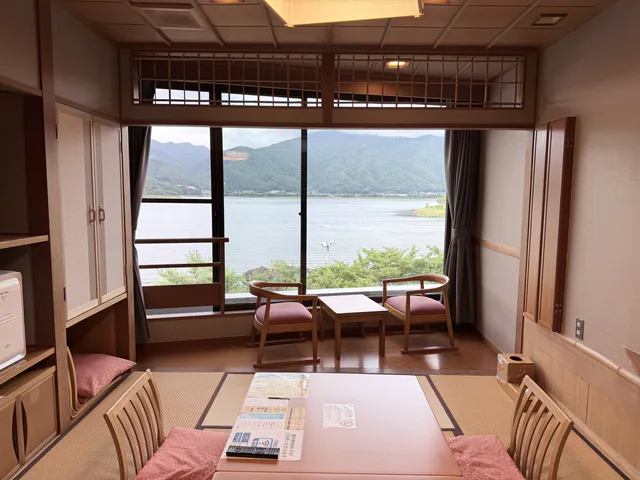 Read nextKawaguchiko ryokan: the MarueiKawaguchiko ryokan: a night at the Wakakusa no Yado Maruei on the south shore. Lake-view room, balcony bath, Mount Fuji rooftop deck, kaiseki dinner.
The catch: from the south shore you can’t see Mount Fuji from the rooms, so you have to go up to the roof.
Where to eat
I ate or had coffee at every place listed here.
Hōtō Fudō, across from the station
Hōtō is the local dish: wide, thick noodles simmered in miso broth with kabocha squash and vegetables, served in an iron pot. At Hōtō Fudō, right across from the station, it’s the only thing on the menu. The house keeps its noodle recipe close: according to Hoshino Resorts’ guide to hōtō restaurants (in Japanese), only three people in the whole chain know it.
A little before 11 a.m. there was already a line outside. Inside, the servers shout, and that’s part of the experience. A pot cost ¥1,320. The house chili blend comes in a little ceramic Mount Fuji.
Kai Rikyū, yakiniku
You grill the wagyu beef yourself at the table, after ordering on a tablet. A display case at the entrance shows the cuts of meat. Lunch was a big meal.
Cisco Coffee, south shore
This café is in a white wooden house with a porch and a deck looking out over the fields. Coffee to go comes in a cup with the café’s logo.
Mt. Fuji Pancake, near the station
They serve soufflé pancakes with cream or blueberries, and a local soda with Mount Fuji on the label (in Japan, “cider” is a fizzy soft drink with no alcohol). The big dining room is all wood, with booths and framed pictures on the walls.
Kōshūya, gyūkatsu
The breaded beef comes out pink inside, and you finish cooking it yourself on a small hot stone. The set comes with rice, soup and pickles.
Tsunagaru Cafe, north shore
This food truck is parked near the Yōhaijo. Prices are written on small wooden boards, and you drink your coffee at the edge of a deck above the lake.
Marusan Bakery, south of the station
This bakery works for a quick breakfast. You can buy melon bread to go and eat it on the benches in front of the shop.
Fujiyama Cookie: skip it
Fujiyama Cookie, on the other hand, isn’t worth the stop. The Fuji-shaped cookies are nothing special, and the box and the shape do most of the work. It’s more marketing than baking.
The Lawson with Mount Fuji on its roof
About 200 m from the station, the Lawson Kawaguchiko Ekimae convenience store went viral on social media: seen from across the street, it looks like Mount Fuji is sitting on its roof. The day I walked by, the mountain was in the clouds. All that was left was a convenience store, with a few visitors posing in front of it anyway.
The crowds by the road caused enough trouble that the town blocked the view with a large black screen in May 2024, then took it down in August that year, according to isfujivisible, a site that tracks the state of this photo spot. Other, lower barriers have gone up since.
It’s not worth a detour: you get a much better view of the same mountain from the north shore of the lake or from Chureito Pagoda. If you do walk past, take your photo from the crosswalk and stay off the road.
Train and bus: getting here and getting around
There are two ways to get here from Tokyo without a car:
- The Fuji Excursion direct train from Shinjuku: ¥4,200, about 2 hours, four round trips a day.
- The express bus from Shinjuku: ¥2,200, about 1 hour 45 minutes, reservation required.
Kawaguchiko Station is also where the sightseeing buses start, including the Red Line, which loops along the north shore and stops at the ropeway and Oishi Park. The pass costs ¥1,500 a day. Route details are on the Fujikyu bus company’s page about the Kawaguchiko sightseeing buses.
These buses won’t get you to Chureito Pagoda in Fujiyoshida. The Chureito Pagoda page covers how to get there by train.
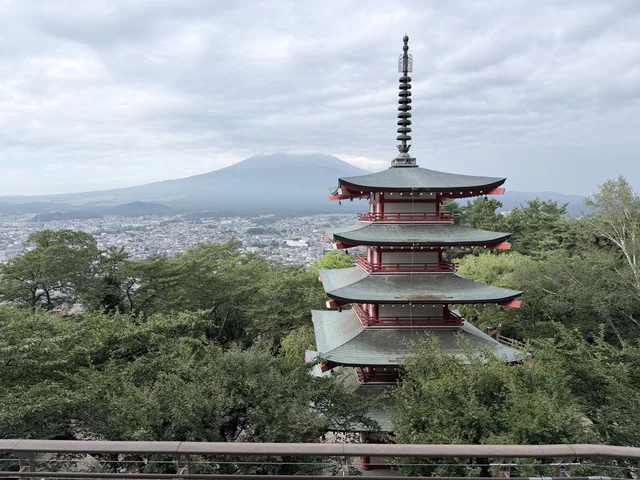 Read nextVisiting Chureito PagodaChureito Pagoda in Arakurayama Sengen Park, Fujiyoshida: the 398 steps, paid parking, the train to Shimoyoshida, crowds and the Mount Fuji view.
What I found
I spent one night in Fujikawaguchiko, then came back twice for the day.
Mount Fuji was clear the first evening and early the next morning. The other days it was hazy or hidden from mid-morning on. I’d plan the day around the morning and the evening, not the middle of the day.
The ropeway and the north shore were quiet before 10 a.m., while the area around the station and the east shore was much busier around noon.
Mistakes to avoid
- Coming for Mount Fuji on a summer afternoon. In August it often hides from mid-morning on.
- Driving to the ropeway with no backup plan. It has no parking lot of its own, and the sign says so in four languages.
- Counting on the Yōhaijo for a quiet photo. Each group gets 3 minutes, and the mountain may be hidden anyway.
- Expecting red kochia in summer. They’re green in August and only turn red in October.
FAQ
Are Kawaguchiko and Fujikawaguchiko the same place?
Yes. Fujikawaguchiko is the name of the town, and Kawaguchiko is the name of the lake and the station. Both refer to the same destination, north of Mount Fuji.
How much is the Mount Tenjo ropeway?
I paid ¥1,000 for an adult round trip, by credit card. The ride up takes three minutes.
When can you see Mount Fuji best from Lake Kawaguchi?
In summer, I saw it clear at sunset and early in the morning. In the middle of the day it was hazy or hidden.
How do you get to Kawaguchiko from Tokyo?
Take the Fuji Excursion direct train from Shinjuku, about 2 hours, or the express bus from Shinjuku, about 1 hour 45 minutes, with a reservation.
Where should I stay in Kawaguchiko for a Mount Fuji view?
I stayed at the Wakakusa no Yado Maruei ryokan, on the south shore. The rooms face the lake, and you see Mount Fuji from the rooftop deck.