
Seeing and photographing
Oishi Park, Lake Kawaguchi
Oishi Park on the north shore of Lake Kawaguchi: kochia, lavender, the bloom calendar, the view of Mount Fuji, bus access and parking.
On this page
Oishi Park runs along the north shore of Lake Kawaguchi, facing Mount Fuji. People come for the flower beds with the mountain across the water, mostly the lavender in early summer and the red kochia in October. I stopped by around noon in August, when the kochia were still green, the lavender had faded and Mount Fuji was barely visible.
At a glance
- Red kochia
- mid to late Octobergreen in summer
- Lavender
- late June to mid-Julyfaded by August
- From the station
- about 30 minby sightseeing bus
- Mount Fuji in August
- barely visiblearound noon, during my visit
Map of Oishi Park and Lake Kawaguchi
Loading map…
- Oishi ParkNorth shore. Kochia, lavender, Mount Fuji across the lake.
- Fujisan Yohaijo toriiPhotos limited to 3 minutes per group.
- Panoramic Ropeway (lower station)Three minutes to the top.
- Kawaguchiko StationEnd of the Fujikyu line and bus terminal.
Kochia in summer: green, not red
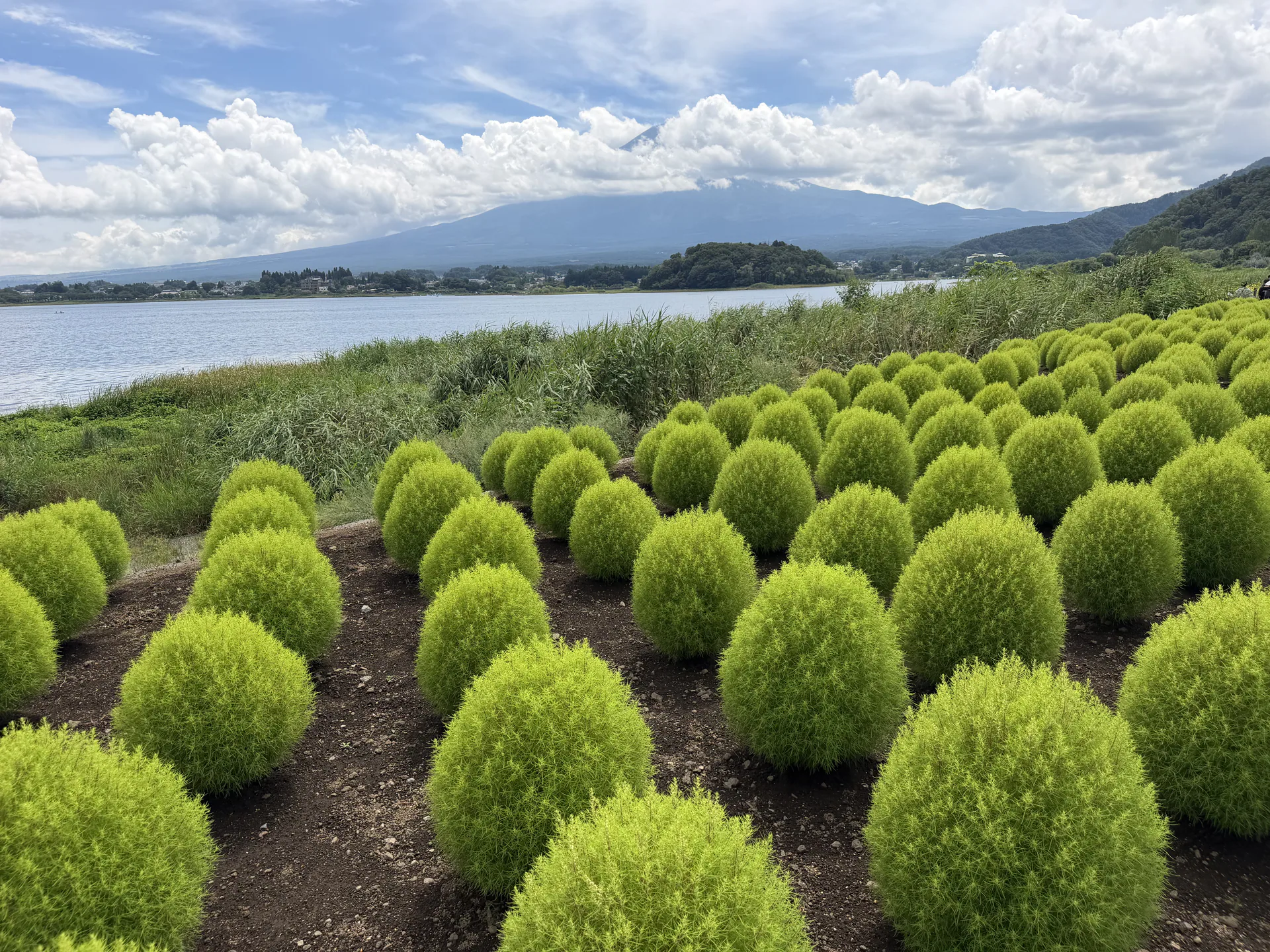
Rows of kochia (summer cypress) line the lake, trimmed into neat round bushes. They’re the plants that turn red in the fall, but in August they were bright green.
Mount Fuji is across the lake, to the south. Around noon it was hidden behind clouds and I could only make out its outline.
A gravel path lined with logs runs between the beds down to the water.
Lavender: already gone in August
There’s a large lavender bed in front of the park building, the Kawaguchiko Natural Living Center, which you’ll spot by its clock tower. In August only gray stems were left, since the lavender season runs from late June to mid-July according to the Yamanashi tourism office.
Other summer flowers
In August the park still had beds of red, white and yellow flowers. There were also small pink flowers by the lake and white hydrangeas near a terrace.
Best time to visit: kochia and lavender calendar
The Yamanashi tourism office’s page on the park’s kochia (in Japanese) gives this calendar, which shifts a little with each year’s weather:
- Lavender: late June to mid-July.
- Green kochia: all summer.
- Kochia starting to turn red: late September to early October.
- Red kochia: mid to late October.
- Golden to brown kochia: early November.
For the view of Mount Fuji, the time of day matters as much as the season. On my August days at the lake it was clear early in the morning and at sunset, but hazy or hidden from mid-morning on.
 Read nextLake Kawaguchi (Kawaguchiko)Lake Kawaguchi and the town of Kawaguchiko: the Mount Tenjo ropeway, the north shore, Oishi Park, a lakeside ryokan, places to eat and how to get there by train or bus.
How to get there: bus and parking
The Red Line sightseeing bus runs from Kawaguchiko Station to the park in about 30 minutes. The sightseeing bus pass costs ¥1,500 a day.
If you’re driving, the park’s lot has 40 car spaces and 7 coach spaces, according to the tourism office.
What I found
I spent 15 minutes at Oishi Park, around noon in August.
The kochia were green, the lavender had faded and Mount Fuji was barely visible behind the clouds. In summer you don’t see the park’s colors or the mountain at their best.
Fifteen minutes was enough to walk around the flower beds.
Mistakes to avoid
- Coming in August for the red kochia. They’re green in summer and don’t turn red until October.
- Coming in August for the lavender. It had faded, since it stops blooming in mid-July.
- Counting on a midday view of Mount Fuji. Around noon it was behind clouds.
FAQ
When can you see the red kochia at Oishi Park?
From mid to late October, according to the Yamanashi tourism office. They start turning red in late September or early October and go golden in early November. In August I saw them green.
Can you see Mount Fuji from Oishi Park?
Yes, across the lake to the south. During my visit around noon in August, it was barely visible behind the clouds.
How do you get to Oishi Park from Kawaguchiko Station?
On the Red Line sightseeing bus, in about 30 minutes according to the Yamanashi tourism office. If you drive, the park has a 40-space parking lot.