
Areas
Fujinomiya, on the Shizuoka side
Fujinomiya, southwest of Mount Fuji: Fujisan Hongu Sengen Taisha and its spring, the World Heritage Centre, Shiraito Falls, a hotel by the station and places to eat.
On this page
- Map of Fujinomiya and Shiraito Falls
- How is the town laid out?
- Fujisan Hongu Sengen Taisha shrine
- Wakutama-ike, the shrine’s spring
- Mt. Fuji World Heritage Centre, Shizuoka
- Shiraito Falls and Otodome Falls
- Where to stay: the Hotel Fujikyu
- Where to eat in Fujinomiya
- Near Fujinomiya: Inokashira and Obuchi-Sasaba
- Which spot should you pick?
- Mistakes to avoid
Fujinomiya is the town on the southwest side of Mount Fuji, in Shizuoka Prefecture. People come for Fujisan Hongu Sengen Taisha, the shrine with its sacred spring, and for Shiraito Falls, about 9 km to the north. I spent two nights there in summer, and Mount Fuji stayed hidden the whole time.
At a glance
- Shrine
- early morningthe courtyard is almost empty
- Shiraito Falls
- about 9 kmon Route 414, according to the signs
- What to eat
- yakisobathe town’s specialty
- The catch
- Mount Fujihidden both days I was there
 Fujinomiya: Hongu Sengen Taisha Shrine and Shiraito Falls
Map of Fujinomiya and Shiraito Falls
Loading map…
- Hotel Fujikyu FujinomiyaI stayed here two nights. Right next to the station.
- Fujinomiya Station
- Mt. Fuji World Heritage Centre, Shizuoka
- Fujisan Hongu Sengen Taisha
- Wakutama Pond
- Omiya Yokocho
- Menya Aoi (ramen)
- Edoya Bakery & Cafe
- Kiserasera izakaya
- Fujiyama Hunter's Beer
- Fuji Takasago sake brewery
- Shiraito Falls
- Otodome Falls
- Jinba Falls (Inokashira)
- Obuchi-Sasaba tea fields
How is the town laid out?
Everything worth seeing in town is within about 1 km of JR Fujinomiya Station. The sign outside the station puts the World Heritage Centre 0.5 km away, and the shrine is right behind it. The covered shopping streets and the Omiya Yokocho food court are in between.
Shiraito Falls is farther north, on Route 414. I got around by rental car and stayed two nights at the Hotel Fujikyu, right next to the station.
The station is on the JR Minobu Line. JR Central sells the Mt.FUJI-ENJOY PASS there, a pass for local trains and other transportation in the area, at ¥2,200 per adult for one day, according to the poster in the station. I didn’t use it.
Fujisan Hongu Sengen Taisha shrine
The shrine is part of the World Heritage site listed as Fujisan, as the sign at the foot of the big red torii points out.
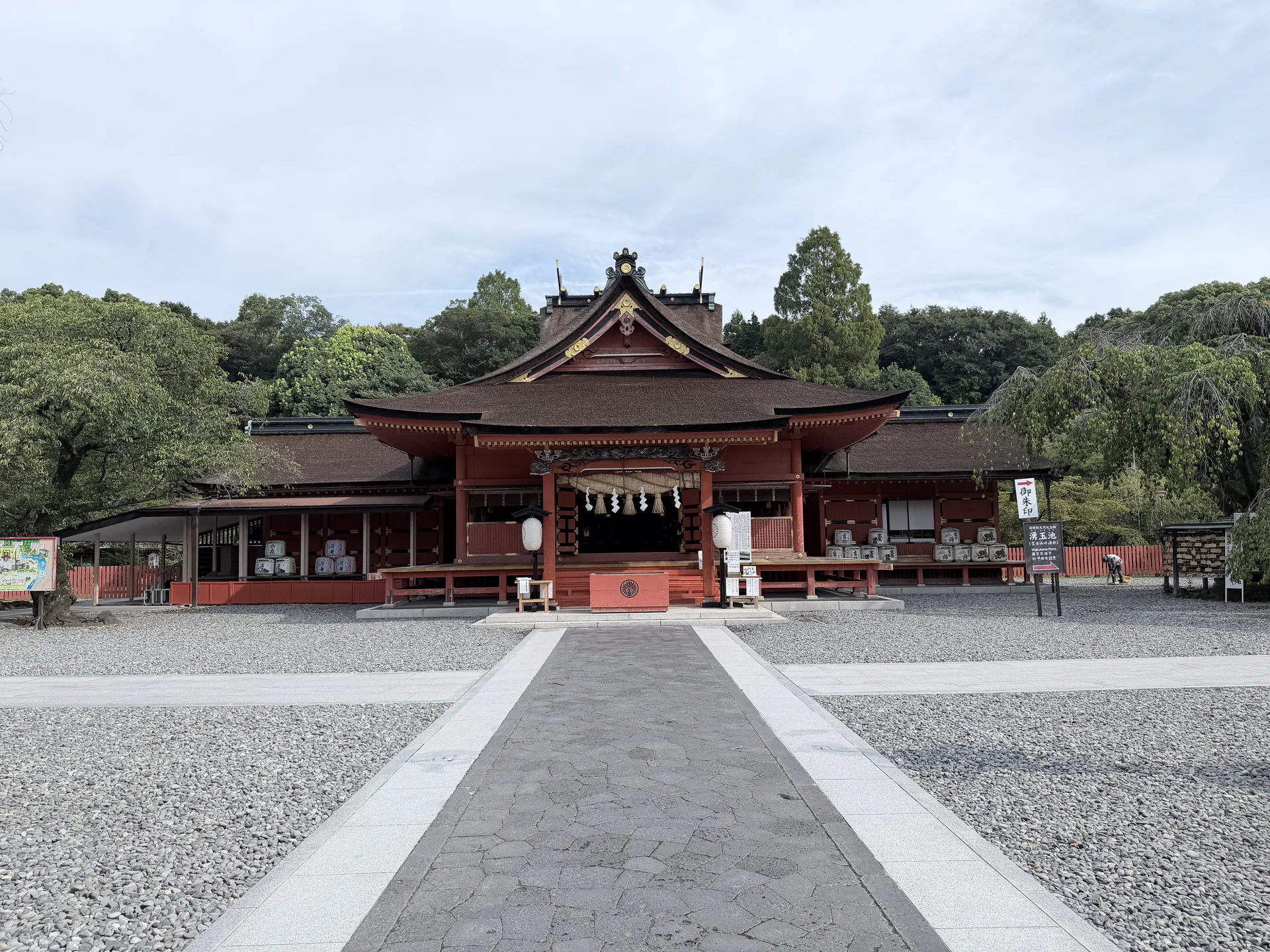
A stone-paved approach, or sandō, lined with stone lanterns runs from the torii to the two-story rōmon gate. Behind it is a gravel courtyard with the haiden, the prayer hall. You can see the two-story honden, the main hall, from the side.
Early in the morning the courtyard was almost empty, with two miko (shrine maidens) sweeping it. The Fuji-shaped omikuji fortunes cost ¥500. The shrine also sells the wooden pilgrim’s staff that Mount Fuji climbers carry, for ¥1,400.
I went back the first evening too. At dusk the lanterns are lit and the rōmon gate glows, and the wet courtyard was nearly deserted.
What you give up: Mount Fuji. You can’t see it from the courtyard, and this isn’t where you come to photograph it.
Wakutama-ike, the shrine’s spring
Next to the haiden, a path leads down to Wakutama-ike, a pond fed by spring water from Mount Fuji. A sign describes it as a special natural monument. The water is clear enough to see the bottom, and bamboo spouts pour it out along a lava rock wall.
Farther down the water flows under two red bridges that reflect in the current. It’s the most photogenic spot at the shrine, and I passed fewer people there than in the courtyard.
You dip the sakura-mikuji fortune in the water at the small Mizuya shrine, on the edge of the pond, and the answer appears. The offering is ¥300.
What you give up: nothing more than at the shrine, since the pond is inside the grounds. Plan on an extra half hour.
Mt. Fuji World Heritage Centre, Shizuoka
The building is an upside-down cone of wooden latticework set above a pool. The whole cone reflects in the water, and on the other side the big red torii standing in the pool does the same. You can take both photos from the plaza without going in.
Inside, a spiral ramp climbs from the plain to the summit with images projected on the walls, then you walk past display cases of volcanic rock. The room at the top is framed on Mount Fuji, but that evening the mountain was in the clouds.
What you give up: the view the top room is built for, when clouds cover the mountain. I didn’t note the admission price.
Shiraito Falls and Otodome Falls
Shiraito Falls is about 9 km from the station on Route 414, according to the signs. It’s also part of the Fujisan World Heritage site. You can see two waterfalls from the same parking lot.
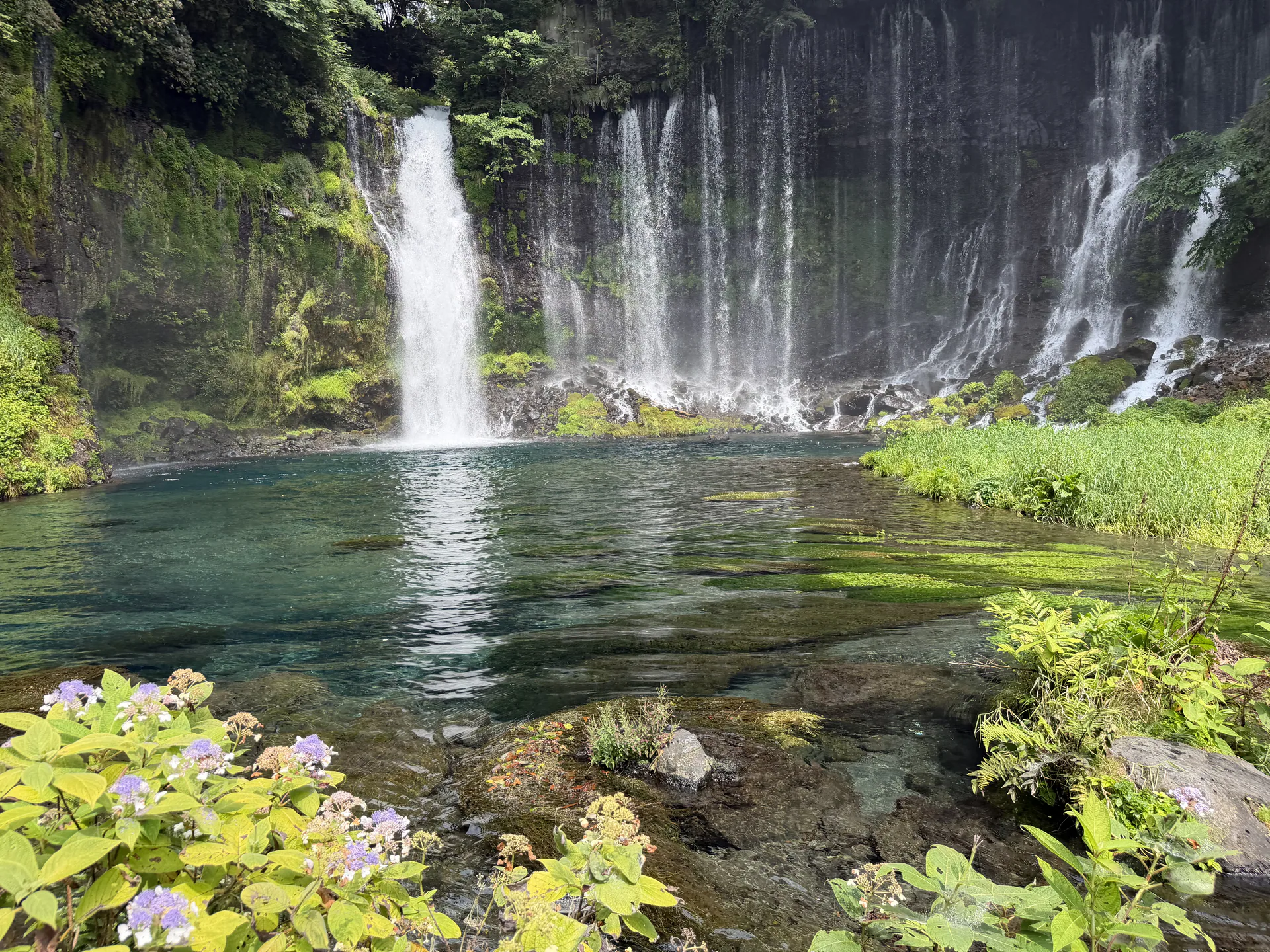
Otodome Falls drops in a single stream into a gorge, ending in a dark blue pool. You look down on it from a viewpoint 200 m from the parking lot.
Shiraito is different: the water seeps out of the lava cliff across its whole width, in separate threads. The path goes down to the edge of the turquoise pool, where you can sit on the rocks. Swimming isn’t allowed.
There were lots of visitors, but they were spread out enough that I could photograph the pool with nobody in the foreground. Around the parking lot there are souvenir shops and a coffee roaster that opens onto a lawn.
What you give up: Mount Fuji, which shows up above the falls on a clear day. I didn’t see it.
Where to stay: the Hotel Fujikyu
I stayed two nights at the Hotel Fujikyu Fujinomiya, right next to the station. My twin room had two beds, a desk and a compact bathroom with a tub. In the morning the window looks out over the station area and the hills.
What it has going for it is the location: you can walk to the shrine, the World Heritage Centre and the restaurants.
You can book it on Booking.com: see the Hotel Fujikyu Fujinomiya on Booking.com. To compare it with other places in town: hotels in Fujinomiya on Booking.com.
 Read nextWhere to stay near Mount FujiWhere to stay near Mount Fuji: a ryokan on Lake Kawaguchi or in Hakone, a hotel in Fujiyoshida or Fujinomiya, mountain huts. By train, by car or on a budget.
Where to eat in Fujinomiya
The town’s specialty is Fujinomiya yakisoba, stir-fried noodles that are firmer than elsewhere, served with red pickled ginger. These are the places I stopped at.
Menya Aoi, ramen near the shrine
I had a bowl of shōyu ramen with chāshū pork, naruto fish cake and bamboo shoots. The restaurant is a few streets from the shrine.
Edoya Bakery & Cafe, by the water
This bakery is in a wood and glass building facing a pool of running water, a short walk from the shrine. I had breakfast there twice: a yakisoba hot dog, a melon pan, some buns and a coffee.
Prices are shown before tax, and the tax is added at the register.
Yakisoba at Omiya Yokocho
Omiya Yokocho is a covered courtyard of small food stalls and tables, across from the shrine. The Fujinomiya yakisoba stand there serves the classic dish, ¥700 for a regular portion, plus some spicier versions.
I walked through in the morning but didn’t eat there.
Kiserasera, izakaya
This is where I tried Fujinomiya yakisoba, along with karaage, gyoza and kimchi. The menu is in Japanese with prices, and you order on your phone.
Fujiyama Hunter’s Beer, craft brewery
This brewery pours its beers on tap in a wood-paneled room, with a few dishes on the chalkboard. One of them, the Mt.FUJI ALE, is a pale ale made with yuzu.
Fuji Takasago, sake brewery
The Fuji Takasago sake brewery still has its black wooden front, with a cedar ball hanging over the door and barrels stacked by the entrance. I only saw it from the outside.
Near Fujinomiya: Inokashira and Obuchi-Sasaba
North of Shiraito, the village of Inokashira has rice paddies and farmhouses at the edge of the forest. Jinba Falls also comes out of the lava there, in small cascades above a turquoise pool. Right next to it, Enshō-ji temple has a dark wooden front.
The day I went, a road was closed while they got ready for the waterfall festival. The sky was gray and Mount Fuji was nowhere to be seen.
East of town, in the city of Fuji, the Obuchi-Sasaba tea fields are known for the view of Mount Fuji above the rows of tea bushes. I went early in the morning and the mountain was completely hidden by clouds. All that was left were the bright green rows and a lone tree on the hill.
A stand offers tea picking: ¥1,000 for 30 minutes.
What you give up: the whole trip, if Mount Fuji is covered, since it’s the reason to come to Obuchi-Sasaba.
Which spot should you pick?
| Spot | What for | Access | What you give up |
|---|---|---|---|
| Hongu Sengen Taisha | the shrine, the lanterns at night | on foot from the station | no view of Mount Fuji |
| Wakutama-ike | the spring, the red bridges | inside the shrine | nothing more |
| World Heritage Centre | the architecture, the museum | on foot, 0.5 km from the station | the view from the top on a cloudy day |
| Shiraito Falls | Shiraito and Otodome | by car, about 9 km | Mount Fuji on a cloudy day |
| Obuchi-Sasaba | the tea fields | by car | the whole point, without Mount Fuji |
One morning is enough for the shrine, the spring and the World Heritage Centre, and another for the falls. By car I did the shrine and Shiraito in the same morning.
What I found
I got in late in the afternoon and saw the World Heritage Centre, then the shrine at dusk. The next morning I went back to the shrine and the spring before driving to Shiraito Falls.
On the last morning I went to Obuchi-Sasaba before leaving town.
In two days Mount Fuji didn’t show once, not from the World Heritage Centre’s terrace and not from the tea fields.
Mistakes to avoid
- Coming to Fujinomiya to see Mount Fuji in summer. I didn’t see it in town, at the falls or at Obuchi-Sasaba.
- Going up to the World Heritage Centre’s top room for Mount Fuji on a cloudy day. It’s framed on the mountain, but all I saw was clouds.
- Taking the prices at Edoya at face value. They’re shown before tax.
FAQ
What is there to see in Fujinomiya?
Fujisan Hongu Sengen Taisha shrine and its Wakutama-ike spring, the Mt. Fuji World Heritage Centre, and to the north, Shiraito Falls and Otodome Falls.
Where is Shiraito Falls?
About 9 km north of Fujinomiya Station on Route 414, according to the signs. Otodome Falls is right next to it, from the same parking lot.
Can you see Mount Fuji from Fujinomiya?
On a clear day, yes. During my two days there in summer it stayed hidden, in town and at Obuchi-Sasaba.
Where can I eat Fujinomiya yakisoba?
I had it at Kiserasera, an izakaya. The Fujinomiya yakisoba stand at Omiya Yokocho, across from the shrine, serves the classic version.
How much time do you need in Fujinomiya?
One morning for the shrine, the spring and the World Heritage Centre, and another for Shiraito Falls.