
Climbing
Climbing Mount Fuji
Climbing Mount Fuji: the four trails compared, the climbing season, the permit and the different rules in Yamanashi and Shizuoka, 5th Station access and mountain huts.
On this page
- Four trails, two prefectures
- Yoshida, the busiest trail
- Subashiri, through the forest
- Gotemba, the longest trail
- Fujinomiya, the shortest and steepest
- The four trails side by side
- The 2026 climbing season
- Permit and reservation: Yamanashi vs. Shizuoka
- Getting to the 5th Station: the private car ban
- Day climb or a night in a mountain hut?
- Where to stay for a day climb
- Altitude sickness
- What to bring
- The crater rim isn’t the summit
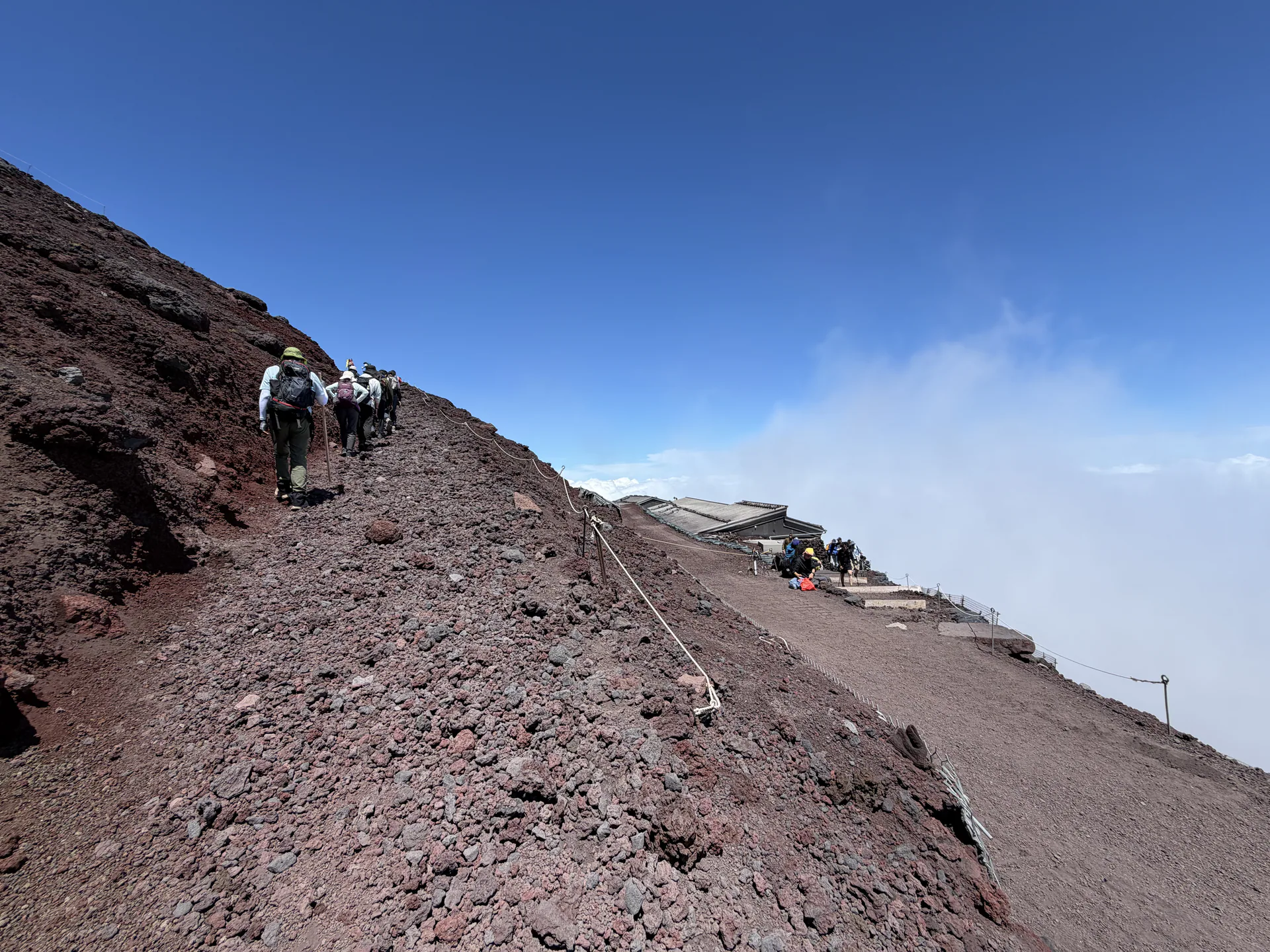
You can only climb Mount Fuji in summer, from early July to early September, on one of four trails that start at the 5th Stations. The permit costs the same everywhere, ¥4,000 per person, but the rules aren’t the same in Yamanashi and Shizuoka. I did the Yoshida Trail in one day: about 4.5 hours up and about 3 hours 10 minutes down.
At a glance
- Trails
- 4Yoshida, Subashiri, Gotemba, Fujinomiya
- 2026 season
- July to Septemberopening July 1 or July 10 depending on the trail
- Permit
- ¥4,000per person, on all four trails
- My time
- about 8 hoursup and down in one day, breaks included
Four trails, two prefectures
The mountain is split between two prefectures. Yoshida starts on the Yamanashi side, to the north, while Subashiri, Gotemba and Fujinomiya start on the Shizuoka side, to the south and east. Each prefecture sets its own rules.
Every trail starts at a 5th Station, where the road ends, somewhere between 1,440 and 2,400 m. The distances and times on this page come from the official Mount Fuji climbing site, which compares the four trails. I only hiked one of them. The other three are described from that source.
Yoshida, the busiest trail
It starts at the Fuji Subaru Line 5th Station, at 2,305 m. The official site gives 6.8 km and about 6 hours 10 minutes up, for 1,450 m of elevation gain. It has more mountain huts than any other trail, and the way up and the way down are two separate paths.
It’s the one I hiked, in one day, in about 4.5 hours up and about 3 hours 10 minutes down, breaks included. Higher up, the Subashiri Trail joins it and they share the same path to the top. The elevation profile, my measured times and the climb step by step are on the Yoshida Trail page.
What you give up: peace and quiet. The trail narrows near the top and the line slows down in places. It’s also the only trail with a daily cap, and your gear gets checked at the start.
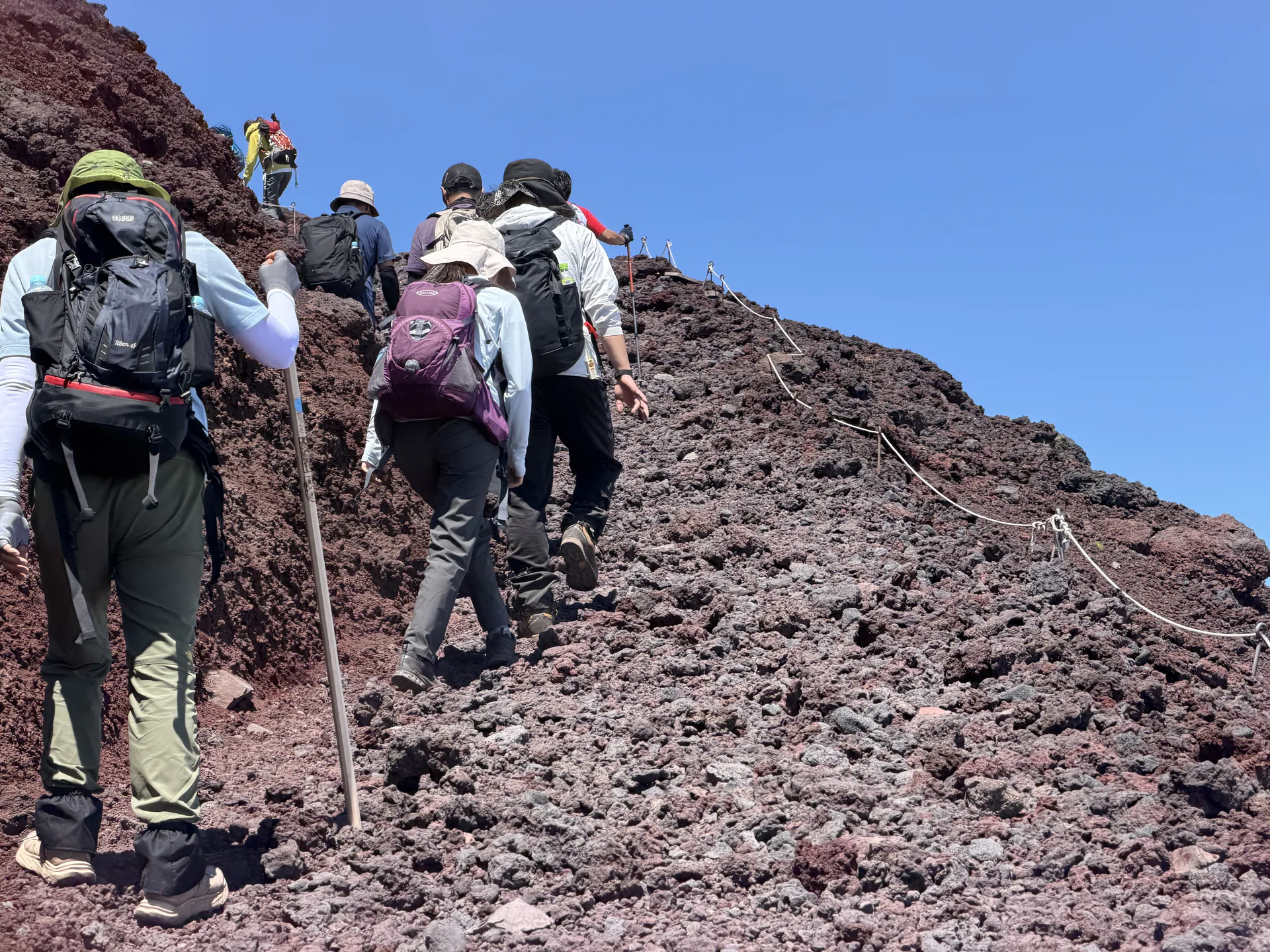 Yoshida Trail: climbing Mount Fuji in one day
 Read nextThe Yoshida Trail up Mount FujiThe Yoshida Trail in one day: shuttle and parking for the Fuji Subaru Line 5th Station, the gear check at the gate, real times from a GPS watch and mistakes to avoid.
Subashiri, through the forest
The Subashiri Trail starts at its 5th Station, at 2,000 m, on the Shizuoka side. The official site gives 6.9 km and about 6 hours 25 minutes up, then 6.2 km and about 3 hours 20 minutes down, for 1,700 m of elevation gain. The lower part goes through forest, and part of the descent is on volcanic sand.
What you give up: a quiet upper section. It merges with the Yoshida Trail at Hon-hachigōme, the original 8th Station at about 3,400 m, so you finish the climb among the Yoshida crowds. You also climb more, since you start 300 m lower than on the Yamanashi side.
Gotemba, the longest trail
The Gotemba Trail starts at the New 5th Station, at 1,440 m. It’s the longest of the four: the official site gives 10.5 km and about 8 hours 40 minutes up, for 2,300 m of elevation gain. On the way down you run down about 5 km of volcanic sand.
What you give up: places to rest and buy food. There are only a few huts, and the day is much longer than on the other three trails.
Fujinomiya, the shortest and steepest
The Fujinomiya Trail starts at the highest 5th Station, at 2,400 m. The official site gives 4.3 km and about 5 hours 10 minutes up, for 1,320 m of elevation gain, then about 2 hours 40 minutes down. At the top it comes out on the side of Kengamine, the highest point, with a steep slope called Umanose in between.
What you give up: variety and an easy grade. The path is steep and you come down the same way you went up.
The four trails side by side
| Trail | Prefecture | Start | Up | Down | Elevation gain | What you give up |
|---|---|---|---|---|---|---|
| Yoshida | Yamanashi | 2,305 m | 6.8 km, 6 hr 10 min | 7.0 km, 3 hr 35 min | 1,450 m | peace and quiet |
| Subashiri | Shizuoka | 2,000 m | 6.9 km, 6 hr 25 min | 6.2 km, 3 hr 20 min | 1,700 m | a quiet upper section |
| Gotemba | Shizuoka | 1,440 m | 10.5 km, 8 hr 40 min | 8.4 km, 3 hr 30 min | 2,300 m | mountain huts |
| Fujinomiya | Shizuoka | 2,400 m | 4.3 km, 5 hr 10 min | 4.3 km, 2 hr 40 min | 1,320 m | an easy grade |
These are official walking times, without breaks. On the trail I hiked I was faster than the official time even with my breaks, so the signs are on the cautious side.
The 2026 climbing season
The 2026 season is over. Yoshida and Subashiri were open July 1 to September 10 (2026 season). Gotemba and Fujinomiya were open July 10 to September 10 (2026 season).
Outside those dates the trails are closed. The dates change every year, and the ones on this page are for 2026.
Permit and reservation: Yamanashi vs. Shizuoka
The fee is the same on both sides, but everything else is different.
Yamanashi side: a daily cap and a gear check
The permit costs ¥4,000 per person per climb. There’s a daily cap: 4,000 climbers per day, mountain hut guests excluded. Booking on the asoview platform, where you pay in advance, is optional and you can still do it on the day.
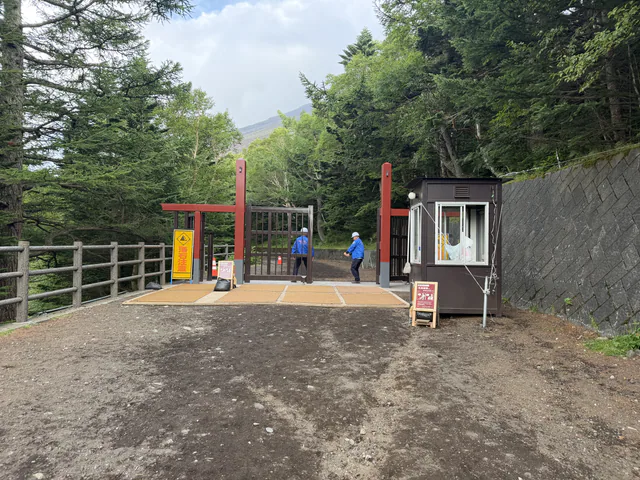
The gate at the 5th Station is closed from 2 p.m. to 3 a.m., except for mountain hut guests. Staff check your gear there: warm layers, a separate rain jacket and rain pants, and hiking boots. I booked a few days ahead and picked a day with a good forecast.
Shizuoka side: the FUJI NAVI app
The permit costs ¥4,000 per person, plus a contribution to the “Mt. Fuji Fund”, from ¥1,000, optional. There’s no daily cap.
The FUJI NAVI app is required, though. You watch an online briefing, then take a quiz where you need every answer right, then pay and get a QR code that you swap for a wristband at the trailhead. You can register on site, but it takes about 30 minutes.
Starting times are restricted the same way as on the Yamanashi side: between 2 p.m. and 3 a.m., you can only start with a booked mountain hut night.
Getting to the 5th Station: the private car ban
In peak season the roads to the 5th Stations are closed to private cars.
- Yoshida: the Fuji Subaru Line is closed from July 3 at 6 p.m. to September 10 at 6 p.m. (2026 season). You park at Fujisan Parking, for ¥1,000 per car per entry, however long you stay, then take the shuttle: ¥3,400 round trip per adult, about 45 minutes each way. The details are on the Yamanashi Prefecture flyer about the Subaru Line closure (in Japanese).
- Subashiri: the Fuji Azami Line is closed from July 1 at 9 a.m. to September 10 at 6 p.m. (2026 season).
- Fujinomiya: the Fujisan Skyline is closed from July 10 at 9 a.m. to September 10 at 6 p.m. (2026 season).
The dates for the Shizuoka roads are on the Shizuoka Prefecture page about closing the Fuji roads to private cars (in Japanese). The road to the Gotemba 5th Station isn’t affected by these closures.
Day climb or a night in a mountain hut?
A day climb means starting before the afternoon gate closure and coming back down the same evening. That’s what I did: I left the 5th Station around 8:30 a.m. and was back around 4:40 p.m.
The other option splits the climb in two. You hike up in the afternoon to a hut at the 7th or 8th Station, sleep a few hours, then start again in the dark to watch the sunrise from the top. Only hut guests can start after 2 p.m., and each hut is booked separately from the permit. Japan Mountain Huts, a private service for booking Mount Fuji huts online lists the huts on the Yoshida, Subashiri and Fujinomiya Trails.
Climbing through the night in one go without stopping at a hut, called dangan tozan or “bullet climbing”, is strongly discouraged by both prefectures. The 2 p.m. to 3 a.m. start ban on all four trails is meant to limit it.
Where to stay for a day climb
If you want an early start without a night in a hut, the easiest base is Fujiyoshida. Fujisan Parking, where the shuttles to the Subaru Line 5th Station leave from, is in Fujiyoshida, at the foot of the Fuji Subaru Line. To find a place: hotels in Fujiyoshida on Booking.com.
I stayed at the Hotel Fuji Toriigate, just over 2 km from the parking lot as the crow flies, and it’s a good choice. The room has two low beds on a platform and a private bathroom with a toilet. The hotel has its own parking lot and a rooftop terrace facing Mount Fuji.
You can book it on Booking.com: see the Hotel Fuji Toriigate.
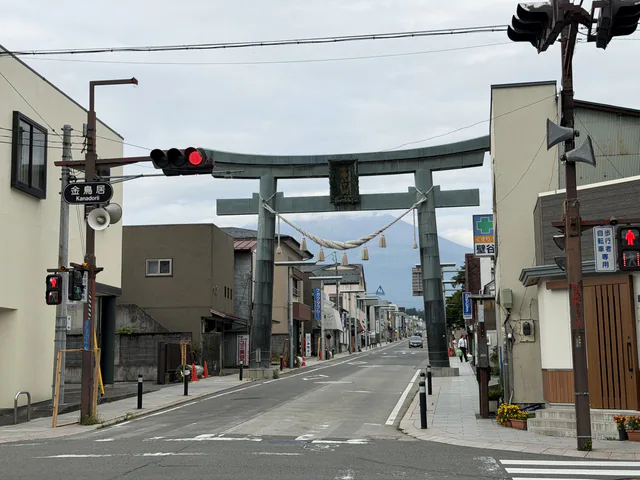 Read nextFujiyoshida and Honcho StreetFujiyoshida at the foot of Mount Fuji: the big bronze torii, Honcho Street and the Gekkoji arcade, Chureito Pagoda, a hotel, a yakitori spot and how to get there.
Altitude sickness
The summit is at 3,776 m. The International Headache Society classification puts high-altitude headache above 2,500 m. All four 5th Stations are below that line, but Fujinomiya is only 100 m short of it.
I had a mild headache toward the end of the climb. At the 8th Station there’s a first aid post right by the trail.
What to bring
The official list is the same for all four trails: hiking boots, a two-piece rain suit, warm layers, a headlamp, water and cash. On the Yamanashi side part of it is checked at the 5th Station gate, and I had to buy rain pants on the spot.
 Read nextMount Fuji climbing gearMount Fuji climbing gear: the official list of essentials and extras, the three items checked at the Yoshida Trail gate, where to buy gear locally and why you need cash.
The crater rim isn’t the summit
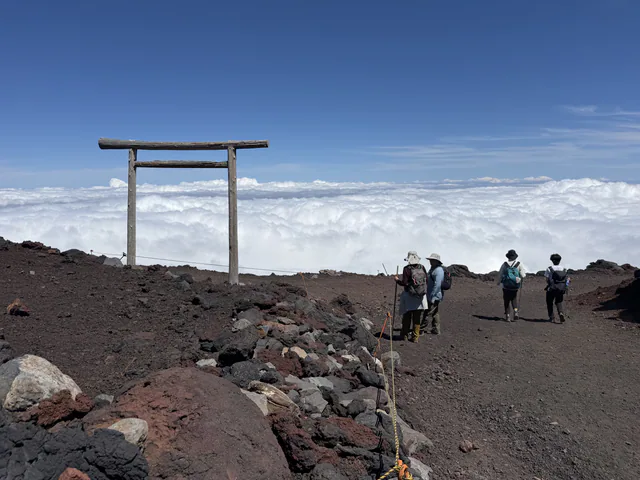
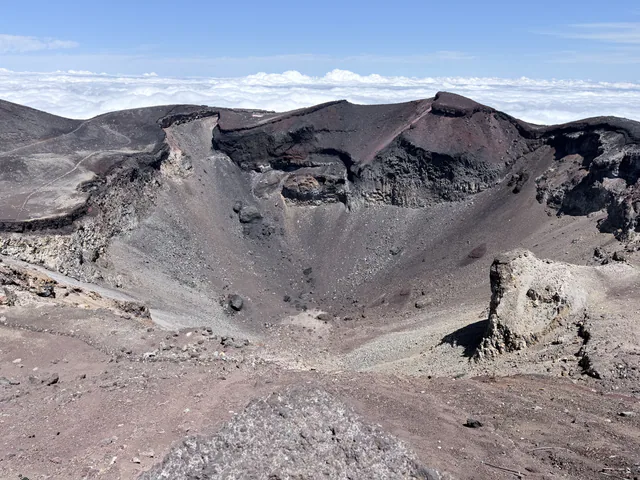
The trails all end on the crater rim. Japan’s highest point, Kengamine at 3,776 m, is a walk around the crater from there, except from Fujinomiya, which comes out on its side.
I stopped at the rim where my trail comes out, at 3,721 m. The person I was traveling with walked around the crater to Kengamine.
 Read nextThe summit of Mount FujiMount Fuji's summit: its exact height, Kengamine, the clockwise crater walk stop by stop, the summit post office and the dangers up top.
What I found
I only hiked the Yoshida Trail, in one day, without a night in a hut. I left the 5th Station around 8:30 a.m. and got back around 4:40 p.m.
The gear check at the gate was for real: I didn’t have rain pants, so I had to buy a pair at the 5th Station before starting.
It was busy, but there was no continuous line. The descent was the hardest part, long and tough on the knees.
I can’t tell you anything about the Shizuoka trails beyond what the official site publishes.
FAQ
How long does it take to climb Mount Fuji?
The official site gives between 5 hours 10 minutes (Fujinomiya) and 8 hours 40 minutes (Gotemba) to go up, without breaks. On the Yoshida Trail it took me about 4.5 hours up and about 3 hours 10 minutes down, breaks included.
Which trail should I take to climb Mount Fuji?
Yoshida has the most huts but also the most people. Fujinomiya is the shortest but steep, and you come down the same way. Subashiri merges with Yoshida at Hon-hachigōme, at about 3,400 m. Gotemba is the longest, with few huts.
How much does it cost to climb Mount Fuji?
The permit was ¥4,000 per person in 2026, on both sides of the mountain. On top of that you pay to get to the 5th Station, often by shuttle bus, and for a night in a hut if you book one.
Do you need a reservation to climb Mount Fuji?
On the Yamanashi side, booking is optional but there is a daily cap. On the Shizuoka side, you have to register in the FUJI NAVI app, with an online briefing, but there is no cap.
When can you climb Mount Fuji?
Only during the official season, from early July to early September. In 2026 Yoshida and Subashiri opened on July 1, Gotemba and Fujinomiya on July 10, and all four closed on September 10.